“Glass hair” and “liquid hair” are everywhere again in 2026: smooth, reflective lengths that catch light almost like polished fabric.
For fine hair, the trend comes with an obvious problem. Most advice for increasing shine involves adding conditioners, oils, masks, glosses and serums. Stack enough of them together and your hair may indeed become reflective. It may also become attached to your scalp like wet tissue paper.
The useful goal is therefore not maximum shine at any cost. It is high shine with movement.
The direct answer
Fine hair can achieve a glassy finish without losing all of its volume if you focus on three things:
- Remove dulling buildup at the scalp and hair surface.
- Smooth the lengths with lightweight conditioning rather than layers of heavy oil.
- Use heat and finishing products precisely, not generously.
Shine is mainly an optical effect. A smoother, more aligned surface reflects light more evenly. Research measuring hair shine has found that cosmetic treatments can change both surface smoothness and measured shine.
That does not mean shiny hair is automatically healthier, or that dull hair is damaged. It means surface condition matters to what your eyes see.
Why glass hair is trending in 2026
Vogue highlighted “glass hair” as one of summer 2026's glossiest looks, with rinse-out glosses, serums, masks and heat protection central to the finish.
The trend fits a broader shift in hair care toward visible polish: less interest in crunchy, over-styled volume and more interest in hair that looks expensive because it moves, reflects light and appears well-conditioned.
Fine hair can participate. It just needs stricter product control.
What actually makes hair look shiny?
Hair shine depends on how light interacts with the surface of the strand.
A rough, weathered or irregular cuticle scatters light in more directions. A smoother, more aligned surface can create a more uniform reflection.
Things that can make hair look dull include:
- product residue
- mineral buildup from hard water
- surface damage from heat or chemical processing
- frizz and irregular strand alignment
- split or weathered ends
- too much dry shampoo or texturizing product
Notice that “add more oil” is not the only solution.
The fine-hair glass-hair routine
Step 1: Start with a clean, lightweight base
Trying to polish hair that is already coated is usually where fine-hair routines go wrong.
Shampoo the scalp thoroughly enough to remove oil, sweat and styling residue. If you use dry shampoo, texture spray, hairspray or silicone-heavy stylers frequently, buildup can reduce movement and make strands separate into heavier sections.
For fine hair, clean roots are not the enemy of shine. They are often the foundation of it.
If your hair feels waxy even after washing, see Why Does My Hair Feel Waxy After Washing?.
Step 2: Condition the lengths, not the scalp
Apply conditioner mainly through the mid-lengths and ends.
The goal is to improve slip and smoothness where the hair is oldest and most weathered while keeping the roots free to lift.
If your roots go flat easily, read Where Should You Apply Conditioner If Your Roots Go Flat?.
Step 3: Decide whether you actually need a gloss
Hair glosses and glazes can add shine and, depending on the formula, may also deposit tone or improve softness.
Fine hair does not need to avoid them automatically. It does need to avoid treating every gloss like a mandatory weekly ceremony.
Start with:
- a lightweight rinse-out gloss
- the minimum recommended amount
- application mainly to the lengths
- less frequent use at first
If the hair looks shinier but flatter, the product may be too rich, too frequent or simply unnecessary.
Step 4: Use heat protectant before styling
Glass-hair styling often involves blow-drying or smoothing tools. That makes heat protection more important, not less.
Apply the amount recommended for your hair length and density. More product does not create more protection once the hair is oversaturated.
For a lower-damage approach, see Heat Styling and Hair Breakage: A Lower-Damage Routine.
Step 5: Dry for alignment and lift at the same time
You do not have to choose between a smooth finish and root volume.
Use the dryer airflow from roots toward ends to encourage a smoother surface, while directing the roots upward or away from their natural fall where you want lift.
For the lengths, controlled tension with a brush can help create a more polished appearance. For fragile hair, the emphasis should be controlled rather than aggressive.
Step 6: Finish with a tiny amount of shine product
This is where many fine-hair routines collapse.
Start with one drop or a very small amount of serum or lightweight oil. Rub it between your palms, then skim it over the lower lengths and ends.
Do not begin at the crown. If your hands still look wet with product, your hair probably does not need all of it.
Hair gloss vs hair oil vs shine serum
| Product | Best for | Fine-hair risk |
|---|---|---|
| Rinse-out gloss | Overall smoothness and shine | Can reduce body if rich or overused |
| Lightweight serum | Polishing frizz and adding surface shine | Easy to overapply near roots |
| Hair oil | Dry or rough ends | Often too heavy for upper lengths |
| Hair mask | Very dry or damaged lengths | Can make fine hair limp if used too frequently |
| Shine spray | Fast finishing effect | May create buildup if layered daily |
Can hard water make glass hair harder to achieve?
Yes, mineral deposition can affect the feel and appearance of hair, although the effect varies by water chemistry, hair condition and routine.
If your hair remains dull, rough or coated despite sensible product use, hard water is one variable worth investigating.
Read Hard Water and Hair: What the Evidence Really Says.
What about cold-water rinsing?
A cold rinse is often presented as the secret to “sealing the cuticle.” That explanation is more dramatic than necessary.
You do not need to finish every shower by subjecting yourself to polar conditions for your hair to reflect light. A thorough rinse and appropriate conditioning matter more than turning wash day into survival training.
Can glass hair make fine hair look thinner?
It can if the styling removes too much volume.
Very straight, tightly smoothed hair can sit closer to the scalp, which may make a part line or lower-density areas more visible. A little root lift often makes the final look more flattering on fine or thinning-looking hair.
The target is smooth lengths with dimensional roots, not ironing every strand into the same plane.
How to keep shine without losing second-day volume
- Keep oils and serums away from the scalp.
- Do not add more shine product every morning by default.
- Use dry shampoo only where oil actually appears.
- Brush gently to redistribute natural oils through the lengths if your hair tolerates brushing well.
- Sleep with hair dry rather than damp.
- Refresh root lift separately from the polished lengths.
Where Vassia Labs fits
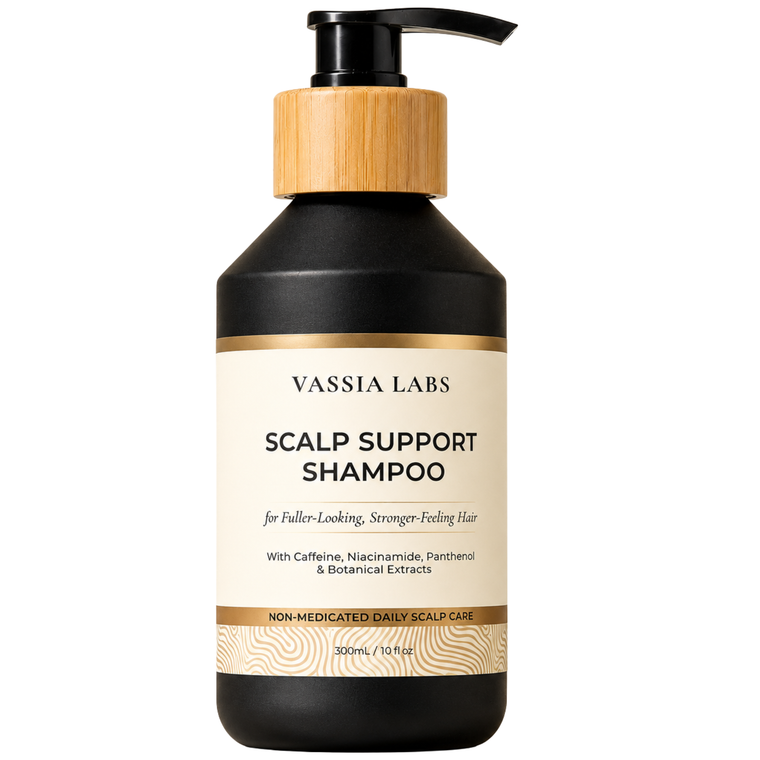
Vassia Labs Scalp Support Shampoo is built for fine, flat and thinning-looking hair that needs a clean, lightweight base.
The formula is fragrance-free, sulfate-free and silicone-free, with scalp-supporting and conditioning ingredients including niacinamide, panthenol, aloe, centella, hyaluronic acid and hydrolyzed wheat protein.
Its job in a glass-hair routine is not to manufacture mirror shine by coating the strands. It is to cleanse away ordinary oil and buildup while leaving fine roots light enough that you can add conditioning and shine only where you actually need them.
That division of labor matters. When the shampoo, conditioner, gloss, serum and oil all try to be the richest product in the routine, fine hair generally loses.
Common glass-hair mistakes on fine hair
- Layering every shine category at once. Gloss + mask + oil + serum + spray is often product redundancy wearing expensive packaging.
- Putting conditioner and oil on the roots. Keep richness where the hair is older and drier.
- Using too much heat for a smoother finish. Repeated high heat can worsen surface damage over time.
- Ignoring buildup. A dull, coated finish sometimes needs cleansing, not another shine layer.
- Making the hair poker-straight when density is a concern. Keep some lift at the root.
Frequently asked questions
Can fine hair use a hair gloss?
Yes. Choose a lightweight formula, start conservatively and judge whether the added shine is worth any loss of volume.
Does shiny hair mean healthy hair?
Not necessarily. Shine is a visual property influenced by surface smoothness, product coating, hair color and styling. Damaged hair can be made temporarily shiny, and healthy hair is not always mirror-like.
Should I use oil before or after blow-drying?
Follow the specific product directions. Some oils or serums are designed for damp hair and heat styling; others are intended only as a finishing product.
How do I get shine without silicone?
Silicones are one effective cosmetic route to smoothness, but they are not the only route. Conditioning agents, proteins, humectants, careful drying and lightweight finishing products can also improve the appearance and feel of hair.
Can I have glass hair and volume?
Yes. Keep the roots clean and lifted, concentrate smoothing products on the lengths, and avoid overloading the upper hair with oils and masks.
Bottom line
The best glass-hair routine for fine hair is not the one with the most shine products. It is the one that creates a smoother surface without taking away the movement that makes fine hair look full.
Clean the roots properly. Condition strategically. Protect the hair from heat. Add gloss and serum in small amounts. Keep some lift at the scalp.
The result should look polished, not laminated.