Hair perfume has gone from niche accessory to a full beauty category in 2026. Allure, Good Housekeeping, Marie Claire, Elle and Harper's Bazaar have all published dedicated coverage this year, while fragrance brands are expanding scent into shampoos, masks, mists and body products.
For anyone who loves fragrance, the appeal is obvious.
For anyone with a sensitive scalp, it raises a different question: if fragrance can irritate skin, is spraying perfume into your hair a bad idea?
The answer depends heavily on where you put it.
The direct answer
Hair perfume can be a reasonable styling or fragrance step for many people, including some people who prefer fragrance-free scalp care, because the two products do different jobs.
A practical approach is:
- use a fragrance-free shampoo on the scalp if you are avoiding fragrance there
- apply hair fragrance mainly to the lengths, not directly onto sensitive scalp skin
- choose a product specifically designed for hair rather than repeatedly spraying ordinary perfume onto the roots
- stop use if you develop itching, burning, redness or rash
This lets scent remain optional and targeted instead of making it part of every scalp-cleansing step.
Why hair perfume is trending in 2026
Fragrance has expanded well beyond traditional eau de parfum. In May 2026, Allure described hair care as a new “fragrance wardrobe,” reflecting the way consumers are layering scent across multiple personal-care categories.
Hair mists are appealing because they:
- add scent without requiring a full perfume application
- can refresh the smell of hair between washes
- are often formulated to feel lighter than traditional perfume
- can be layered with body fragrance
- turn hair movement into part of the scent experience
Some formulas also include cosmetic conditioning or shine ingredients.
Hair perfume vs regular perfume
They can contain overlapping fragrance materials, but they are not necessarily the same formula in a different bottle.
Hair-specific mists may be designed with:
- lower or different alcohol systems
- conditioning ingredients
- lighter fragrance concentration
- ingredients intended to reduce a dry feel
That does not make every hair perfume “healthy” for hair, and it does not make ordinary perfume automatically destructive. It means the finished formula matters.
If you plan to spray something on your hair regularly, a product formulated and labeled for that use is the more logical starting point.
Why fragrance can be a problem for sensitive scalps
Fragrance is a well-known trigger for allergic contact dermatitis in susceptible people.
The American Academy of Dermatology lists the scalp among common areas where fragrance-related contact dermatitis can appear and recommends “fragrance free” products for people trying to avoid fragrance exposure.
Possible signs of a reaction include:
- itching
- burning
- redness
- flaking
- rash
- swelling
If you already know fragrance triggers your scalp, spraying hair perfume directly along the part line is not an especially clever loophole.
Does that mean fragrance-free shampoo and hair perfume contradict each other?
No.
Fragrance-free shampoo is useful because it removes fragrance from a product that is massaged directly across the scalp, often repeatedly and in warm water.
Hair perfume is optional and can be applied only to the lengths.
Think of it as separating scalp care from scent preference.
You can choose a neutral cleanser for the skin and add fragrance later to the part of the hair that tolerates it.
This also gives you more control. If a scent bothers you, you can stop using the mist without replacing your entire cleansing routine.
How to use hair perfume on fine hair
1. Start with dry, styled hair
Unless the product directions say otherwise, use hair perfume as a finishing step.
2. Spray from a distance
A light mist creates more even distribution than saturating one small section.
3. Focus on the mid-lengths
For a sensitive scalp, avoid spraying directly onto the part, hairline or crown.
For fine hair, this also helps keep the roots from becoming damp or coated.
4. Start with one or two sprays
Fine hair makes excess product obvious. You are trying to create a scent trail, not establish a restricted airspace around your head.
5. Check whether the formula adds weight
Some hair mists include oils, shine agents or conditioning ingredients. Useful in moderation, these can flatten very fine hair when heavily applied.
Where should you spray hair perfume?
Good starting areas include:
- lower mid-lengths
- ends
- underside of longer hair
- a hairbrush, if the product specifically allows that use
Avoid eyes, face and irritated skin, and follow the product instructions.
What if you have a fragrance allergy?
If you have confirmed fragrance allergy or recurrent contact dermatitis, the safest approach is generally to avoid the trigger rather than experiment with clever placement.
A dermatologist may use patch testing to help identify specific allergens.
“Unscented” also does not always mean fragrance-free. The AAD notes that unscented products can contain fragrance used to mask other odors.
For more guidance, read Fragrance-Free Shampoo: Who May Benefit Most?.
Can hair perfume make fine hair greasy?
It can if the formula contains richer conditioning ingredients or if you apply too much.
Fine hair tends to show oil and residue quickly because strands group together. If a mist makes the lengths stringy or the roots collapse, use less or move application lower down the hair.
Can hair perfume replace dry shampoo?
No.
Hair perfume changes scent. Dry shampoo absorbs some oil. Wet shampoo actually cleans the scalp and hair.
These are different functions, despite a beauty industry's recurring desire to sell one bottle as a solution to all known human problems.
If hair smells stale because the scalp is oily, sweaty or carrying days of product buildup, washing may solve more than covering the odor with additional fragrance.
Can you spray perfume on a hairbrush?
Some people use this technique to distribute scent more lightly, but it depends on the product and brush material.
If the hair perfume directions allow it, misting the brush and letting excess alcohol flash off briefly before brushing can create a softer application. Do not assume this is appropriate for every fragrance or every brush.
What ingredients should fine hair look for?
There is no universal “best” ingredient list, but fine hair usually benefits from formulas that:
- feel lightweight
- do not rely on heavy oils as the main carrier
- dry without stickiness
- do not make strands clump together
- are clearly labeled for hair use
If your scalp is sensitive, the most important variable may simply be keeping the scented product off the scalp.
Where Vassia Labs fits
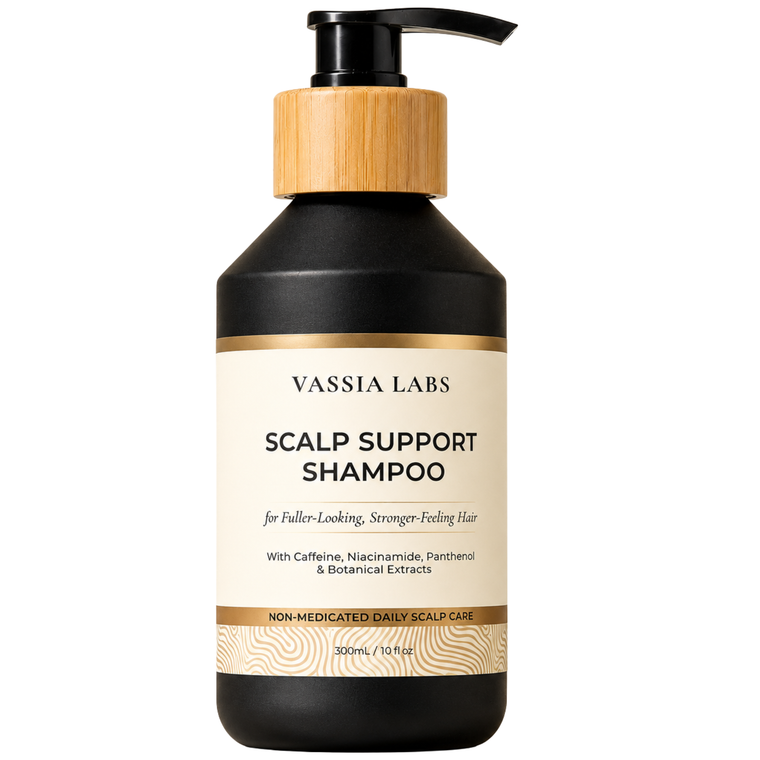
Vassia Labs Scalp Support Shampoo is completely fragrance-free and is designed for fine, flat and thinning-looking hair.
That does not mean Vassia Labs believes fragrance itself is morally corrupt. It means fragrance is unnecessary for the cleansing job the product is designed to do, and removing it gives sensitive or scent-averse customers one less variable on the scalp.
If you enjoy fragrance, a fragrance-free wash can actually make hair perfume more flexible: cleanse with a neutral base, then choose whether, where and how much scent you want afterward.
The shampoo is also sulfate-free and silicone-free and is designed to cleanse everyday oil and buildup without a heavy root coating.
A simple fragrance-aware routine
- Wash the scalp with a cleanser that suits your skin and hair type.
- Condition the mid-lengths and ends as needed.
- Dry and style the hair.
- If you want scent, apply a hair-specific mist lightly to the lengths.
- Keep it off irritated or reactive scalp areas.
- Stop if symptoms develop.
This gives each product a job instead of making your shampoo responsible for cleansing, perfume, therapy, emotional support and whatever else the label designer managed to fit on the bottle.
Frequently asked questions
Is hair perfume bad for hair?
Not automatically. The effect depends on the formula, frequency and how much you use. Hair-specific mists may be formulated differently from ordinary perfume.
Can I use hair perfume every day?
If your hair and scalp tolerate the product and it does not create buildup, daily use may be acceptable according to the label directions. Fine hair may need less product.
Can sensitive-scalp users wear hair perfume?
Some can if the fragrance stays on the lengths and does not contact reactive skin. People with known fragrance allergy may need to avoid fragranced products more broadly.
Is fragrance-free the same as unscented?
No. “Unscented” products can contain fragrance materials used to mask other odors. If you are avoiding fragrance because of sensitivity, look specifically for “fragrance free.”
Will hair perfume make my shampoo scent last longer?
It can add or reinforce scent, but if you use a fragrance-free shampoo it gives you a neutral base so the hair perfume is the only intentional fragrance layer.
Bottom line
Hair perfume is one of 2026's clearest beauty trends, and there is no reason fine hair has to sit it out.
The smartest approach is separation: keep scalp cleansing functional and keep fragrance optional.
If your scalp prefers fragrance-free products, use them there. If your lengths tolerate a hair mist and you enjoy scent, apply it lightly away from the skin.
It is a far more controllable system than forcing your scalp to participate in every fragrance trend simply because your hair happens to be attached to it.