Ingredient lists for thinning-hair shampoos have become increasingly ambitious: caffeine, rosemary, niacinamide, peptides, saw palmetto, proteins, hyaluronic acid, zinc, biotin.
The problem is not that these ingredients are meaningless. The problem is that they often get discussed as if every ingredient performs the same way in every formula, at every concentration, with any contact time.
For fine or thinning-looking hair, a better question is: what job is this ingredient supposed to do in a shampoo?
This guide breaks the most useful categories down without turning the ingredient list into a medical promise.
First: the shampoo base matters more than the hero ingredient
A shampoo is primarily a cleansing system.
If the base leaves fine hair coated, tangled, overly stripped or difficult to style, an impressive botanical list will not rescue the experience.
For fine hair, useful fundamentals include:
- effective removal of oil and styling residue
- a clean rinse
- conditioning that does not overwhelm the roots
- scalp comfort
- compatibility with regular use
The finished formula matters more than counting how many fashionable ingredients appear on the label.
1. Caffeine
Caffeine is one of the most common actives in modern thinning-hair products.
Laboratory and small clinical studies have investigated caffeine around hair follicles, which is why it appears in both shampoos and leave-on scalp treatments.
The evidence is interesting but should be interpreted carefully. Contact time, concentration and formulation matter, and a rinse-off shampoo should not automatically inherit the claims of a leave-on treatment.
In practical terms, caffeine can be a reasonable ingredient in a scalp-focused formula without being presented as a guaranteed regrowth treatment.
Read Caffeine in Hair Products: What the Evidence Says.
2. Niacinamide
Niacinamide is vitamin B3 and is widely used in skin care for barrier-support and conditioning functions.
Its move into scalp care fits the broader 2026 “skinification” trend.
For shampoo, its most defensible role is as part of a formula designed around scalp condition and comfort rather than as a stand-alone hair-growth claim.
Read Niacinamide for the Scalp: Why It Appears in Hair Care.
3. Rosemary
Rosemary is one of the most commercially popular hair-care botanicals of the last several years.
A frequently cited clinical trial compared rosemary oil with 2% minoxidil over six months. That makes rosemary scientifically more interesting than many trend ingredients, but it does not prove that every rosemary-containing shampoo produces the same result.
Oil concentration, delivery system, contact time and the finished formula are all different.
In shampoo, rosemary can be part of a broader scalp-care formula. It should not be treated as a regulatory loophole for drug-like promises.
Read Rosemary in Shampoo: What It Can and Cannot Do.
4. Panthenol
Panthenol, also called pro-vitamin B5, is primarily useful for the hair fiber.
It is valued for conditioning, moisture retention and improving how strands feel.
For fine hair, this matters because cosmetic fullness is not only about root lift. Damaged, rough strands can snap, tangle and look thinner through the lengths.
Panthenol helps support softness and manageability without requiring the very heavy conditioning systems that can flatten fine hair.
Read Panthenol for Hair: How Pro-Vitamin B5 Changes the Feel of Strands.
5. Hydrolyzed proteins
Hydrolyzed proteins are broken into smaller fragments so they can be incorporated into hair-care formulas.
They are commonly used to improve the feel of damaged hair, reduce roughness and create temporary body.
For fine or fragile hair, hydrolyzed wheat protein can be useful because it supports the cosmetic structure of the fiber without pretending to change follicle biology.
Protein is not universally better, however. If a formula leaves your hair stiff or rough, more protein is unlikely to solve that.
Read Hydrolyzed Wheat Protein for Fine and Fragile Hair.
6. Aloe and centella
Aloe vera and centella asiatica are better thought of as scalp-comfort and conditioning ingredients than dramatic hair-growth actives.
That may sound less exciting, but a shampoo you can use consistently without unnecessary discomfort is more valuable than a theoretically powerful formula you hate using.
Read Aloe Vera in Shampoo and Centella Asiatica for Scalp Care.
7. Hyaluronic acid and betaine
Fine hair still needs hydration. It simply needs hydration without unnecessary weight.
Hyaluronic acid and betaine are humectant-style ingredients that help support moisture balance in cosmetic formulas.
They offer a different approach from coating the hair in heavy oils or butters, which can be too much for roots that flatten easily.
Read Hyaluronic Acid for the Scalp.
8. Zinc PCA
Zinc PCA combines zinc with pyrrolidone carboxylic acid and is commonly used in skin and scalp products aimed at oil balance and conditioning.
For people whose fine roots become oily quickly, this type of ingredient can make sense as part of a larger formulation.
Again, the finished shampoo matters more than the presence of one ingredient halfway down the label.
9. Ginseng
Ginseng has a long history in traditional medicine and is increasingly common in modern scalp products, especially those influenced by Korean beauty.
Preclinical research has investigated ginsenosides and hair biology, but evidence from a botanical extract in a cosmetic shampoo should not be stretched into a guaranteed growth claim.
Its most sensible role is as one component in a broader scalp-focused formula.
Read Ginseng in Hair Care: What Research Suggests.
10. Saw palmetto
Saw palmetto is often marketed in products aimed at hormonally influenced thinning because laboratory research has examined its interaction with 5-alpha-reductase pathways.
Clinical evidence for topical cosmetic shampoos remains limited.
That makes it a promising-but-not-proven ingredient rather than a substitute for established medical treatments.
Read Saw Palmetto in Hair Products: Promising, but Not Proven.
What about biotin?
Biotin is almost impossible to avoid in the thinning-hair category, largely because it is easy to understand and easy to market.
True biotin deficiency can affect hair, but deficiency is uncommon. Adding biotin to a rinse-off shampoo is not the same as correcting a nutritional deficiency.
Biotin can exist in a cosmetic formula without deserving top billing.
Read Biotin Shampoo: Useful Cosmetic or Marketing Shortcut?.
What should you actually look for on a label?
Instead of shopping by one hero ingredient, use a hierarchy.
- Does the shampoo clean your scalp properly?
- Does it rinse without leaving fine roots coated?
- Does your scalp remain comfortable with regular use?
- Does the formula include useful conditioning support for fragile strands?
- Are the ingredient claims proportional to the evidence?
This approach is less exciting than chasing a new miracle ingredient every six weeks. It is also much more likely to produce a routine you can sustain.
Where Vassia Labs fits
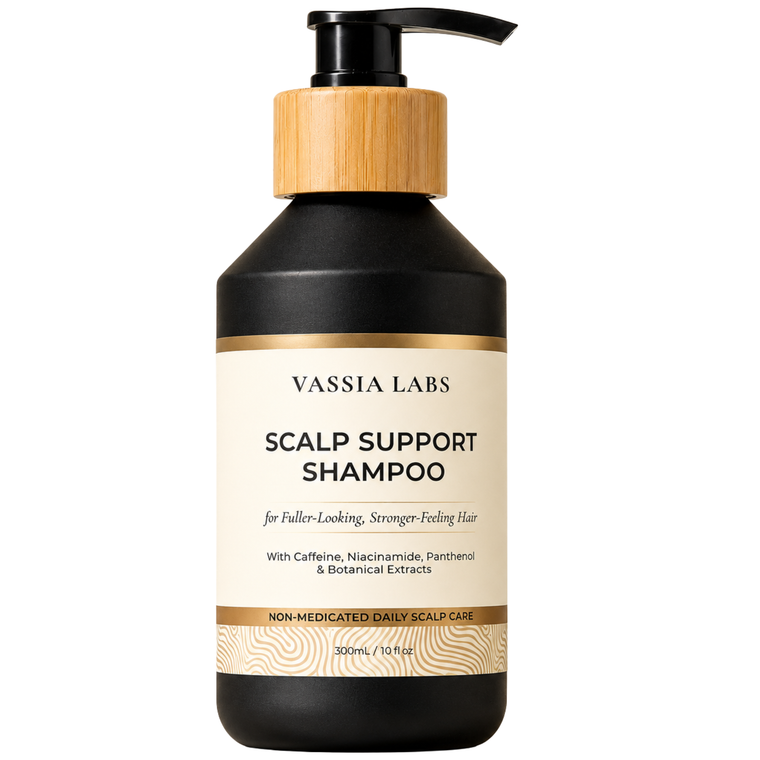
Vassia Labs Scalp Support Shampoo combines multiple ingredient roles rather than relying on a single headline active.
The formula includes caffeine, niacinamide, rosemary extract, panthenol, ginseng, aloe, centella, hyaluronic acid, zinc PCA, betaine, hydrolyzed wheat protein, saw palmetto, biotin and vitamin E in a fragrance-free, sulfate-free and silicone-free cleansing base.
The product is designed for fine, flat and thinning-looking hair with an emphasis on scalp care, lightweight cleansing, less breakage and fuller hair.
It is a cosmetic shampoo, not a drug treatment for hair-loss disorders.
Frequently asked questions
What is the best ingredient for thinning hair shampoo?
There is no single ingredient that makes a shampoo “best.” The cleansing system, finished formulation, scalp tolerance and your actual hair concern matter more than one fashionable active.
Is rosemary better than caffeine?
They have different evidence bases and are used in different types of formulas. A direct ranking is not especially meaningful without comparing complete products and intended outcomes.
Are sulfate-free shampoos always better for fine hair?
No. Sulfate-free describes the surfactant system, not the overall quality of the formula. A sulfate-free shampoo can still cleanse strongly, mildly, well or badly depending on the full formulation.
Can shampoo treat female pattern hair loss?
A cosmetic shampoo should not be relied on as the sole treatment for a diagnosed hair-loss disorder. A dermatologist can assess the cause and discuss evidence-based treatment options.