Hair care has acquired a new vocabulary in 2026: biomimetic peptides, scalp aging, root anchoring, hair longevity, oxidative stress.
Some of the ideas are scientifically legitimate. Some are useful product-development concepts. And some become much less impressive once translated from launch-event language into ordinary English.
If you have fine or thinning-looking hair, here is what “biomimetic hair care” actually means and how to decide whether a high-tech formula deserves space in your routine.
What does “biomimetic” mean?
Biomimetic means designed to imitate or interact with a process found in biology.
In cosmetics, the word may describe peptides that resemble naturally occurring signaling sequences, lipids designed to resemble barrier components, or materials engineered to interact with hair in a particular way.
It is a broad concept, not a regulated guarantee of effectiveness.
A product can be genuinely sophisticated and biomimetic. Another can use the word mainly because “contains conditioner” was unlikely to survive the marketing meeting.
Why is biomimetic hair care trending now?
The broader hair-care market is shifting from styling-only claims toward scalp health, prevention and long-term maintenance.
That shift is being described as hair longevity: protecting the condition, appearance and resilience of hair and scalp over time rather than waiting for visible damage and then trying to reverse it.
Recent launches have pushed the language further, combining peptides, antioxidants and scalp-barrier claims in leave-on treatments.
For consumers, the useful part of this trend is the move toward prevention. The risky part is assuming every futuristic term equals a proven biological outcome.
Where peptides fit
Peptides are short chains of amino acids. Different peptides are designed for very different purposes.
In hair care they may be used to condition the hair fiber, interact with damaged areas, support the cosmetic feel of strands or target scalp biology in leave-on formulations.
Evidence should be judged peptide by peptide and product by product.
A study on one proprietary peptide complex does not prove every peptide shampoo strengthens roots or grows hair. “Peptides” is a category, not a single ingredient with one effect.
What about antioxidants and scalp aging?
Oxidative stress is a legitimate biological concept, and the scalp is exposed to UV radiation, pollution, inflammation and normal aging processes.
Research has also examined scalp-barrier condition in relation to hair retention. In one randomized clinical trial, a regimen containing antioxidant and barrier-supporting ingredients including niacinamide, panthenol and caffeine improved several scalp and hair measures compared with placebo.
That is interesting evidence for a specific multi-product regimen. It should not be simplified into “niacinamide shampoo prevents hair aging.”
Finished products, concentrations and study designs matter.
Is “root anchoring” a real thing?
Hair is physically anchored within the follicle, and researchers can measure shedding and hair retention.
However, consumer phrases such as “root anchoring technology” can refer to very different mechanisms or company-specific test methods.
When a product makes a striking number-based claim, look for:
- the number of participants
- whether the study was controlled
- how long the study lasted
- whether the product tested is the same one being sold
- whether the endpoint was actual hair count, shedding, breakage or a self-reported score
Without that context, impressive percentages are mostly decorative mathematics.
Does fine hair need a high-tech serum?
Not necessarily.
Fine hair has immediate mechanical and cosmetic needs that are much less glamorous:
- clean roots
- minimal residue
- gentle detangling
- less heat and traction damage
- conditioning that does not flatten the hair
- consistent washing based on scalp oiliness
A sophisticated leave-on serum can be an optional layer. It should not distract from a wash routine that is poorly matched to your hair.
Shampoo and serum do different jobs
A rinse-off shampoo is built primarily to cleanse. A leave-on serum has far more contact time and can be designed around sustained exposure to particular ingredients.
This is important when comparing claims.
An ingredient with useful leave-on data may still be reasonable in shampoo, but the same biological result should not be assumed.
If you want a deeper comparison, read Scalp Serum vs Shampoo: What Does Thinning-Looking Hair Actually Need?.
How to evaluate a “hair longevity” product
- Define the outcome. Is the product promising less breakage, less shedding, improved scalp comfort or actual regrowth?
- Check the format. Leave-on and rinse-off products should not be treated as interchangeable.
- Look for finished-product testing. Ingredient citations are useful, but product-specific data are stronger.
- Separate cosmetic from medical claims. Fuller-looking hair is not the same as treating androgenetic alopecia.
- Judge usability. A treatment you stop using because it makes fine roots greasy has theoretical value and practical failure.
Where Vassia Labs fits
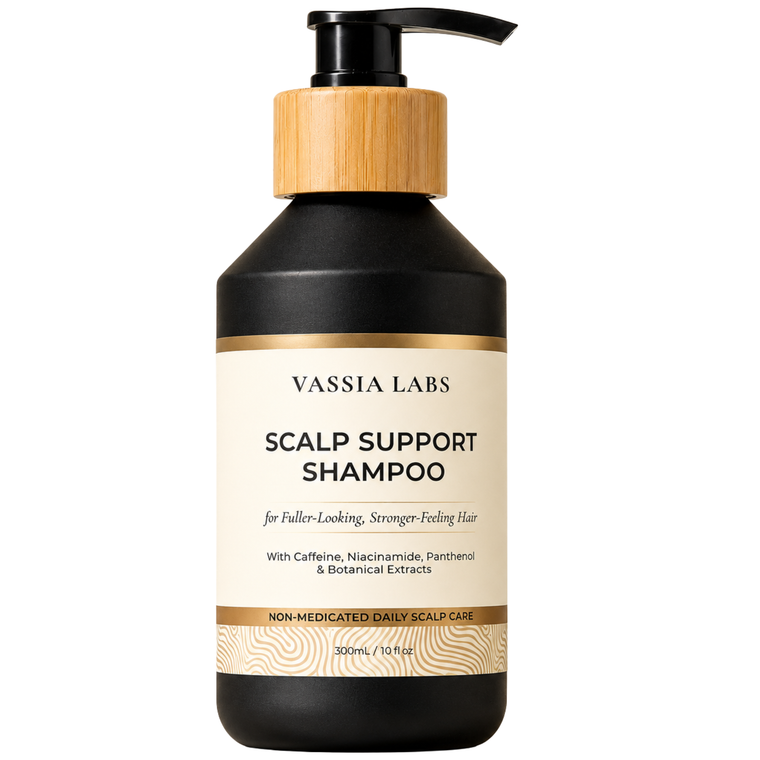
Vassia Labs Scalp Support Shampoo takes a deliberately less theatrical approach.
It combines niacinamide, caffeine, panthenol, rosemary extract, ginseng, aloe, centella and hydrolyzed wheat protein in a fragrance-free, sulfate-free and silicone-free shampoo designed for everyday scalp cleansing and fine-hair volume.
The formula is intended to leave roots feeling lighter and strands stronger-feeling and fuller-looking. It does not claim to reverse biological aging or replace medical treatment for hair loss.
For the wider trend, read What Is Hair Longevity? The 2026 “Hairspan” Trend Explained, and for peptides specifically see Peptides in Hair Care: What They Can and Cannot Do for Thinning Hair.
Frequently asked questions
Are biomimetic peptides proven to regrow hair?
Not as a broad category. Evidence varies by peptide, formulation and study. Do not generalize results from one proprietary complex to every peptide product.
What is hair longevity?
It is a consumer and product-development framework focused on maintaining scalp condition, hair strength and appearance over time. It is not a medical diagnosis.
Is a scalp serum better than shampoo for active ingredients?
A leave-on serum generally provides much longer contact time, but whether that matters depends on the ingredient and the evidence for the specific formula.