Direct answer: “hair longevity” or “hairspan” is a 2026 beauty-industry way of talking about keeping the scalp comfortable and preserving the condition, strength and manageability of existing hair for as long as practical. It is not a medical diagnosis, and a cosmetic routine has not been proven to extend the biological lifespan of individual hair follicles.
The useful part of the trend is much less dramatic: reduce avoidable breakage, excessive heat, tight styling and product buildup; wash according to your scalp’s actual oil and residue; condition fragile lengths; and investigate real density changes rather than trying to shampoo them away.
What does “hair longevity” actually mean?
The term reflects a broader move in beauty from instant cosmetic effects toward maintenance and prevention. For hair, that can include protecting the hair fiber from repeated damage, supporting a comfortable scalp routine and preserving color and manageability.
That is a reasonable goal. The trouble begins when “longevity” gets stretched into claims that a shampoo can permanently optimize follicles, rebalance the microbiome, reverse every kind of thinning or biologically extend the growth phase without product-specific evidence.
Hair is a fiber once it leaves the scalp. You can reduce further weathering and improve its cosmetic condition, but you cannot make a split strand biologically heal itself.
The four useful parts of the hairspan idea
1. Reduce mechanical damage
Wet hair is easier to stretch and damage. Rough towel rubbing, aggressive detangling and repeated tight hairstyles can all increase mechanical stress.
Use gentle blotting, detangle with minimal tension and avoid hairstyles that repeatedly pull at the same areas. If your hair is already fragile, read The Complete Guide to Thinning-Looking & Fragile Hair.
2. Use heat deliberately
Heat is not forbidden, but temperature, distance and exposure matter. A controlled hair-dryer study found more surface damage at higher temperatures; in that experiment, a dryer held about 15 cm away and kept moving produced less damage than prolonged natural drying.
That does not make one exact dryer setting a universal prescription. It does support a sensible principle: avoid concentrating extreme heat in one place, and use the lowest effective temperature.
See How to Dry Fine Hair With Less Breakage.
3. Clean the scalp according to need
The American Academy of Dermatology recommends washing based on how quickly the scalp becomes oily or dirty. Straight, oily hair may need frequent washing, while drier or more textured hair may need less.
There is no evidence-based rule that fine hair must be limited to two or three washes a week. If your roots become oily, sweaty or coated sooner, wash sooner with a formula you tolerate.
For fine hair, the target is clean roots without unnecessary roughness through the lengths. Read The Complete Guide to Fine Hair.
4. Condition where the hair needs it
Conditioner reduces friction and can help fragile hair resist breakage during detangling and styling. Fine hair usually needs less product than coarse hair, and rich conditioner placed directly at the roots can reduce volume.
Apply the amount that gives adequate slip, usually concentrating on mid-lengths and ends. More product is not automatically more protection.
What hair longevity does not mean
It does not mean:
- massaging the scalp has been proven to make every person’s hair grow faster
- a cosmetic shampoo can “unclog” follicles and reverse hair loss
- everyone needs a protein mask on a fixed calendar
- everyone with fine hair should wash only a few times per week
- “sulfate-free” automatically means gentle
- “pH-balanced” automatically means ideal
- biotin or botanical ingredients in rinse-off shampoo are equivalent to medical treatment
Those claims are appealing because they turn a complicated biology problem into a bathroom checklist. Biology has declined the offer.
What about scalp massage?
Gentle scalp massage can feel pleasant and may help distribute shampoo during washing. It should not be presented as a guaranteed circulation-based hair-growth treatment.
If you enjoy massage, use fingertips rather than nails and avoid aggressive pressure on an irritated or inflamed scalp.
Do you need supplements for “hair longevity”?
Hair growth depends on adequate nutrition, but supplementation is not automatically beneficial when no deficiency exists. Sudden shedding, fatigue, restrictive dieting or suspected deficiency should be assessed appropriately rather than treated by buying an increasingly impressive collection of gummies.
A balanced diet with adequate protein and micronutrients supports general health. That is different from claiming that a supplement will increase density in everyone.
How shampoo fits into a long-term routine
Shampoo’s primary job is cleansing. It removes oil, sweat and residue from the scalp and hair. For long-term hair care, the best cleanser is one that does that job at the frequency you need without repeatedly leaving the scalp uncomfortable or the hair unnecessarily rough.
Surfactant chemistry and pH are part of that equation. For the technical details, read Shampoo Surfactants Explained and Does Shampoo pH Matter?.
A practical hair-longevity routine for fine hair
- Wash when the scalp needs it. Use oil, sweat and buildup as the signal, not a fixed calendar.
- Apply shampoo mainly to the scalp. Let lather move through the lengths during rinsing.
- Rinse thoroughly. Residue can reduce both comfort and volume.
- Condition fragile lengths. Fine hair usually needs less product and less root application.
- Blot rather than rub. Reduce friction while hair is wet.
- Use controlled heat. Keep the dryer moving and avoid the hottest setting unless truly necessary.
- Reduce chronic tension. Rotate hairstyles and avoid repeated pulling.
- Treat actual density change separately. A widening part, sustained shedding or bald patches are not merely styling problems.
Where Vassia Labs fits
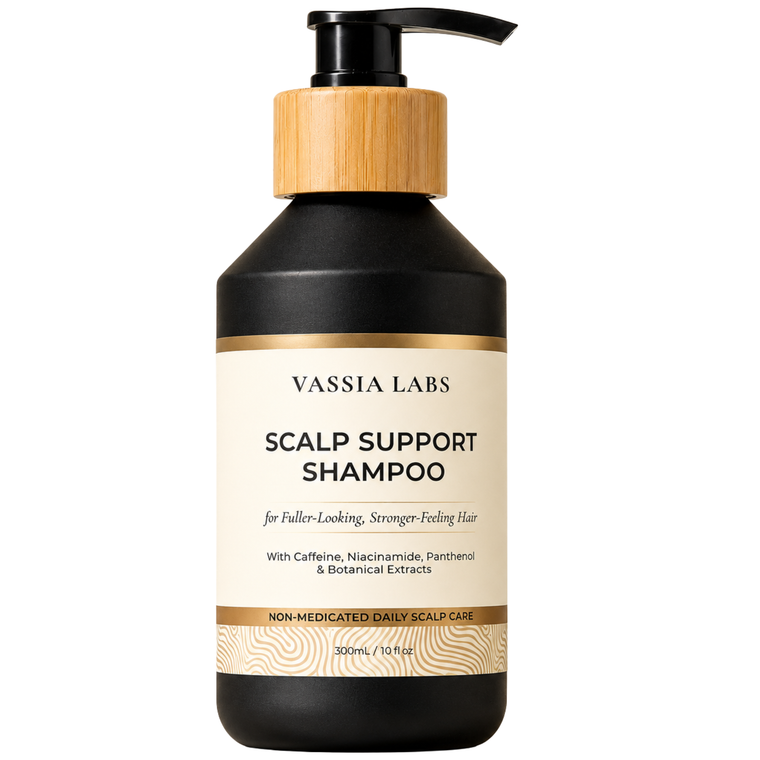
Vassia Labs Volumizing Shampoo is a non-medicated cosmetic cleanser designed for fine, flat and thinning-looking hair. It is fragrance-free, sulfate-free and silicone-free and is intended to remove everyday oil and residue while leaving a lightweight finish.
Its role in a “hair longevity” routine is practical rather than mystical: clean roots, manageable strands and less unnecessary weight. We do not claim that the finished shampoo has been shown to extend follicle lifespan or permanently alter the scalp microbiome.
When hair changes need more than a longevity routine
Seek appropriate professional assessment for sudden or substantial shedding, bald patches, a progressively widening part, scalp pain or burning, thick scale, sores, scarring or another meaningful unexplained change.
A long-term care routine can reduce avoidable cosmetic damage. It cannot diagnose why hair density is changing.
Frequently asked questions
Is hairspan a scientific diagnosis?
No. It is an industry and consumer trend term used to describe long-term hair maintenance.
Can shampoo increase hair lifespan?
A cosmetic shampoo can support cleanliness and reduce some avoidable sources of roughness or buildup, but it has not been established that ordinary shampoo extends the biological lifespan of follicles.
How often should fine hair be washed for hair longevity?
According to scalp oil, sweat and buildup. There is no universal two- or three-times-per-week rule.
Does hair longevity mean avoiding heat completely?
No. Controlled heat, appropriate distance and reduced exposure are more practical than treating every dryer as forbidden.
Does Vassia Labs claim to support the scalp microbiome?
No finished-product microbiome claim is made here. The shampoo is positioned for lightweight cosmetic cleansing and scalp-focused care.