Direct answer: Fine hair has a smaller individual strand diameter, so relatively small amounts of oil, conditioner and styling residue can make it look flat or separated. A good fine-hair routine prioritizes clean roots, lightweight conditioning, controlled product amounts, gentle handling and washing according to your scalp’s actual oil and buildup. If your overall density is changing, treat that as a separate question from strand fineness and visible volume.
This guide is the main Vassia Labs resource for understanding fine hair. It connects the problems that often arrive together: flat roots, oily roots, buildup, fragile lengths, breakage, low volume and the confusing overlap between fine, thin and thinning-looking hair.
What fine hair actually means
Fine hair describes the diameter of each individual strand. It does not tell you how many hairs are growing on your scalp.
You can have fine strands and high density, coarse strands and low density, or fine strands and low density at the same time. That distinction matters because a product can improve the appearance and feel of fine hair without changing follicle count.
For the full distinction, read Fine Hair vs Thin Hair: The Difference Changes Your Routine.
Why fine hair gets weighed down so easily
When each strand has a small diameter, a little extra material represents a larger amount of weight relative to the strand itself. Scalp oil, rich conditioner, leave-in products, dry shampoo, texture sprays and smoothing serums can therefore change the way fine hair sits surprisingly quickly.
Common signs that weight is part of the problem include:
- roots that look full after styling but flat later in the day
- hair that separates into stringy sections
- a crown that looks oily sooner than the lengths
- soft hair that still feels coated
- conditioner improving softness while reducing root lift
- volume products working at first and then contributing to buildup
If you want the formulation-level explanation, see What Makes a Shampoo Lightweight?.
The five priorities of a good fine-hair routine
1. Clean the scalp according to need
Fine hair often shows scalp oil quickly. That does not mean everyone with fine hair must wash daily, and it does not mean everyone should stretch wash day for an arbitrary number of days.
Wash when your roots become oily, coated, uncomfortable or visibly separated. The objective is a scalp that feels clean and comfortable without repeatedly stripping fragile lengths.
Apply shampoo mainly to the scalp, massage gently with the pads of your fingertips and rinse thoroughly. Let the lather move through the lengths instead of aggressively rubbing older hair together.
For exact product amounts, read How Much Shampoo Should You Use for Fine Hair?. For a complete wash-day sequence, use The Best Wash-Day Routine for Fine, Flat Hair.
2. Condition strategically rather than heavily
Fine hair still benefits from conditioning because reduced friction can make detangling and styling gentler. The problem is usually not conditioner as a category. It is the amount, richness and placement.
Start through the mid-lengths and ends. Use less near the roots unless the formula is specifically designed for scalp use. If your hair becomes separated or stringy after conditioning, read Why Does Conditioner Make My Fine Hair Look Stringy?.
3. Control buildup before adding more volume products
Fine hair is unusually good at demonstrating the law of diminishing returns. One lightweight styling product may help. Four layers of mousse, oil, dry shampoo and texture spray may create the opposite effect.
When roots feel waxy, gritty, unusually stiff or immediately flat after washing, review product accumulation and rinsing before buying a stronger volumizer.
Useful related guides include Can Scalp Buildup Make Hair Look Thinner? and How Often Should You Use Clarifying Shampoo?.
4. Protect fragile lengths
Small-diameter strands can be vulnerable to mechanical and heat damage. Breakage through the lengths can reduce visible fullness even when the follicles themselves are unchanged.
Helpful habits include blotting rather than rubbing wet hair, detangling gently, limiting tight hairstyles, using the lowest effective heat and avoiding repeated high-tension styling.
Read How to Dry Fine Hair With Less Breakage, Heat Styling and Hair Breakage and How to Sleep With Fine or Fragile Hair.
5. Create root lift during drying
Clean hair can still dry flat if the roots remain in one downward position while wet. Root direction matters.
Gently lifting sections, changing your part while drying or directing airflow against the natural growth direction can create temporary lift without requiring a large amount of styling product.
For the complete volume system, see The Complete Guide to Flat Hair and Root Volume.
Fine hair and oily roots
Fine hair can appear greasy quickly because oil becomes visually obvious when narrow strands group together. That can make the part look wider and the roots look less dense even when no immediate change in follicle count has occurred.
The practical answer is usually not to coat the scalp with more products. It is to find a cleansing frequency and shampoo formula that reliably removes the amount of oil and residue your routine creates.
If your scalp is both oily and easily irritated, see Shampoo for Fine Hair With Oily Roots and a Sensitive Scalp.
Fine hair and flat roots
Flat roots are usually influenced by several factors at once: strand diameter, scalp oil, product residue, conditioner placement, humidity, hair length, natural root direction and drying technique.
A shampoo can create a lighter foundation, but it cannot permanently force roots upward. The most reliable approach combines clean roots with sensible product placement and drying technique.
Use the dedicated Flat Hair and Root Volume Guide for the full troubleshooting system.
Fine hair vs thinning-looking hair
Fine hair is a strand characteristic. Thinning describes reduced density or a meaningful change in how much hair is present.
Flatness, oil and wet strands can make the scalp more visible, so cosmetic volume can improve the appearance of fullness. But persistent widening of the part, recession, sudden shedding, bald patches or a clear reduction in density deserve separate assessment.
Start with Fine Hair vs Thin Hair and Hair Shedding vs Hair Breakage.
Fine hair and sensitive scalps
A sensitive scalp creates an extra constraint: you need enough cleansing to keep roots light, but not a routine that repeatedly leaves the scalp itchy, tight or uncomfortable.
Fragrance-free formulas can be useful for people who prefer to remove added fragrance as a potential variable. Sulfate-free and silicone-free preferences may also suit some routines, but no single label claim determines whether a whole formula will work for one person.
Read The Sensitive Scalp Shampoo Guide.
Which ingredients matter for fine hair?
There is no one hero ingredient that turns an ordinary shampoo into a medical hair-growth treatment. For fine hair, the shampoo base, cleansing performance and finished feel matter first.
Ingredients such as panthenol and hydrolyzed proteins can support cosmetic softness, manageability or temporary body. Niacinamide, aloe and centella are commonly used in scalp-focused formulas. Caffeine, rosemary, ginseng and saw palmetto are popular in thinning-hair products, but their presence in a rinse-off shampoo should not be exaggerated into a guaranteed regrowth claim.
For the detailed ingredient map, read The Shampoo Ingredient Encyclopedia for Fine Hair.
A simple fine-hair routine
- Wash when the scalp needs cleansing. Do not follow a rigid schedule that leaves roots greasy or uncomfortable.
- Apply shampoo mainly to the scalp. Clean the crown, hairline, behind the ears and nape.
- Rinse thoroughly. Residue can reduce movement and scalp comfort.
- Condition the lengths. Start lower on the hair and use the smallest amount that gives adequate slip.
- Blot gently. Avoid rough towel friction.
- Dry for lift. Reposition roots rather than allowing every strand to dry straight downward.
- Use one primary styling product. Add more only when it solves a specific problem.
- Clarify only when needed. Treat buildup, not a calendar.
Where Vassia Labs fits
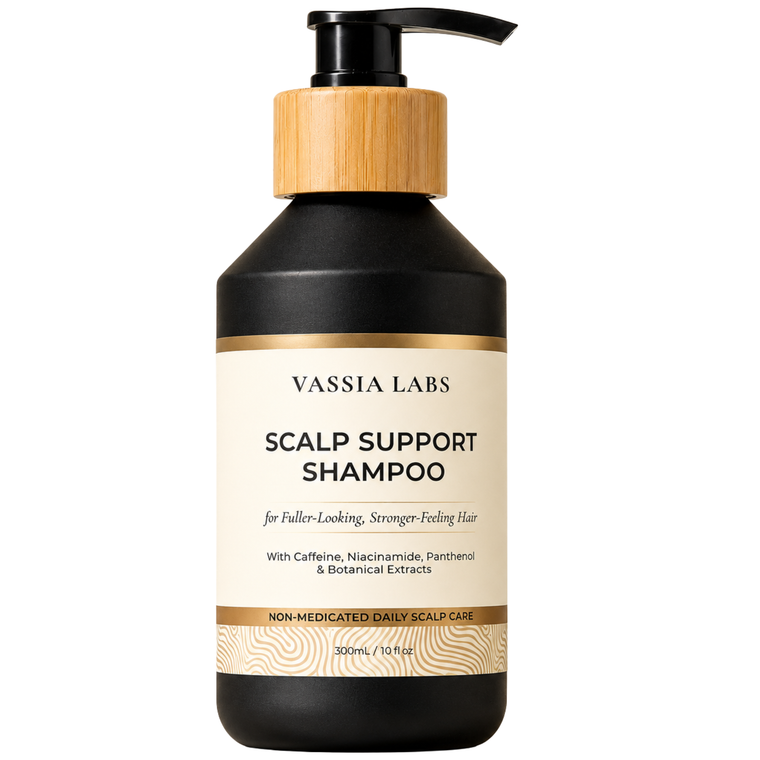
Vassia Labs Volumizing Shampoo for Fine, Flat & Thinning Hair is a non-medicated cosmetic shampoo built around the overlap between fine strands, flat roots, visible buildup and scalp care.
The formula is fragrance-free, sulfate-free and silicone-free and includes caffeine, rosemary, niacinamide, panthenol, saw palmetto, ginseng, aloe, centella asiatica, hyaluronic acid, zinc PCA, betaine, hydrolyzed wheat protein, vitamin E, biotin and chamomile.
Its job is deliberately less dramatic than the average miracle bottle: cleanse the scalp and roots, reduce unnecessary heaviness, support softer and stronger-feeling strands and create a lighter foundation for fuller-looking volume.
Frequently asked questions
Is fine hair the same as thin hair?
No. Fine describes strand diameter. Thin usually describes lower density. You can have one, the other or both.
How often should fine hair be washed?
Wash according to scalp oil, sweat and product buildup. Some people with oily, straight fine hair prefer frequent washing, while drier scalps may need less.
Should fine hair avoid conditioner?
No. Fine hair can benefit from conditioning. Use a lightweight amount and concentrate richer formulas through the mid-lengths and ends if roots flatten easily.
Why does my fine hair look thinner when wet?
Water makes strands clump together and sit closer to the scalp, increasing scalp visibility. That visual effect does not by itself prove a sudden loss of density.
Can shampoo permanently thicken fine hair?
A cosmetic shampoo can improve cleanliness, feel, separation and visible fullness. It does not permanently change genetically determined strand diameter or create new follicles.
What is the best shampoo type for fine, flat hair?
Look for effective cleansing and a lightweight finish rather than a heavy coating. Scalp comfort, residue, conditioning level and your actual oil production matter more than a single marketing word.