Direct answer: for fine hair with oily roots and a sensitive scalp, look for a shampoo that is strong enough to remove your real oil and buildup but simple enough to avoid unnecessary scalp triggers. Fragrance-free is a useful starting point, and fine roots generally do better with a lightweight finish than with heavy conditioning at the scalp.
If your scalp gets red, burns or repeatedly reacts after washing, do not assume “oily” means you need a harsher cleanser. Oil production and skin sensitivity are separate problems.
What to look for: quick comparison
| Need | Look for | Avoid assuming |
|---|---|---|
| Oily fine roots | Effective cleansing + clean rinse | More aggressive always means cleaner |
| Sensitive scalp | Fragrance-free, simple routine, good rinse quality | “Natural” automatically means non-irritating |
| Flat hair | Lightweight conditioning and low root residue | Rich moisture belongs at the scalp |
| Dry ends | Condition mid-lengths and ends separately | One richness level must suit the entire strand |
Why oily roots and scalp sensitivity can happen together
Oiliness and sensitivity describe different things. Your scalp can produce plenty of sebum while still reacting to fragrance, hot water, harsh washing, product residue or individual ingredients.
Fine hair can make the oiliness look more dramatic because sebum spreads easily along smaller strands. Once the roots become coated, they group together and lose lift.
For the oil-focused guide, read Fragrance-Free Shampoo for Fine, Oily Hair: What to Look For.
1. Choose cleansing strength based on your routine
If your scalp becomes oily within a day or you use dry shampoo and styling products regularly, the shampoo still needs to remove that material effectively.
A formula that feels gentle but leaves the roots coated is not solving the problem. Likewise, shampooing repeatedly with a very aggressive cleanser can create discomfort without giving you better volume.
Judge the result after the hair dries. The roots should feel clean, separate and light rather than slick, waxy or tight.
2. Fragrance-free can simplify a sensitive-scalp routine
Fragrance is not required for cleansing performance. Some people tolerate it perfectly well, while others find fragranced hair products uncomfortable or simply prefer to avoid them.
If your scalp is easily irritated, a fragrance-free formula removes one common variable and makes it easier to work out whether the rest of the routine suits you.
For a full sensitive-scalp checklist, see How to Choose a Shampoo for a Sensitive Scalp.
3. Keep heavy conditioner away from oily roots
Fine hair can need conditioning through the lengths, particularly when it is colored, heat-styled or fragile. The mistake is often applying the same amount everywhere.
Concentrate richer conditioner through the mid-lengths and ends. If the scalp is oily and the roots collapse easily, avoid coating that area unless the conditioner is specifically designed for scalp use.
If your ends are dry while the scalp is oily, read How to Choose a Shampoo for an Oily Scalp and Dry Ends.
4. Watch for buildup that mimics extra oiliness
Dry shampoo, texture spray, leave-in conditioner and styling products can combine with natural oil. That residue may make the scalp feel dirty sooner and can flatten fine roots even when your actual sebum production has not changed.
When strands clump together, more scalp may also show between them, making hair appear less full.
See Can Scalp Buildup Make Hair Look Thinner?.
5. Do not assume sulfate-free means weak cleansing
Sulfate-free shampoos use other surfactants. Some clean very lightly and others clean thoroughly. The label alone does not tell you how the finished formula will perform.
If you prefer sulfate-free hair care, look for one that still removes the level of oil and styling residue your routine creates.
Read Sulfate-Free Volumizing Shampoo for Fine Hair: What Actually Matters.
6. Wash as often as your scalp needs
There is no prize for stretching wash day when your scalp is oily and uncomfortable. Some people with fine, oily hair prefer frequent cleansing because volume disappears quickly as oil accumulates.
The right frequency is the one that keeps the scalp clean and comfortable while the lengths remain manageable. Adjust conditioner placement and handling rather than automatically forcing longer intervals between washes.
7. Keep the rest of the routine simple while troubleshooting
If your scalp is reacting, changing five products at once makes it difficult to identify the cause. Use a straightforward shampoo, a conditioner on the lengths and only the styling products you actually need.
Once the scalp is comfortable and the roots stay cleaner, add other products one at a time.
Specific routines by scalp and hair pattern
- Oily + fine + sensitive: wash when oil requires it, use fragrance-free shampoo at the scalp, rinse thoroughly, condition lower down.
- Oily roots + dry ends: cleanse the scalp properly and treat the ends separately with a small amount of conditioner.
- Fine + dry-shampoo buildup: remove the accumulated powder fully before assuming your scalp simply “produces too much oil.”
- Fine + active redness or burning: simplify the routine and stop a product that repeatedly triggers symptoms. Persistent inflammation deserves assessment.
Where Vassia Labs fits
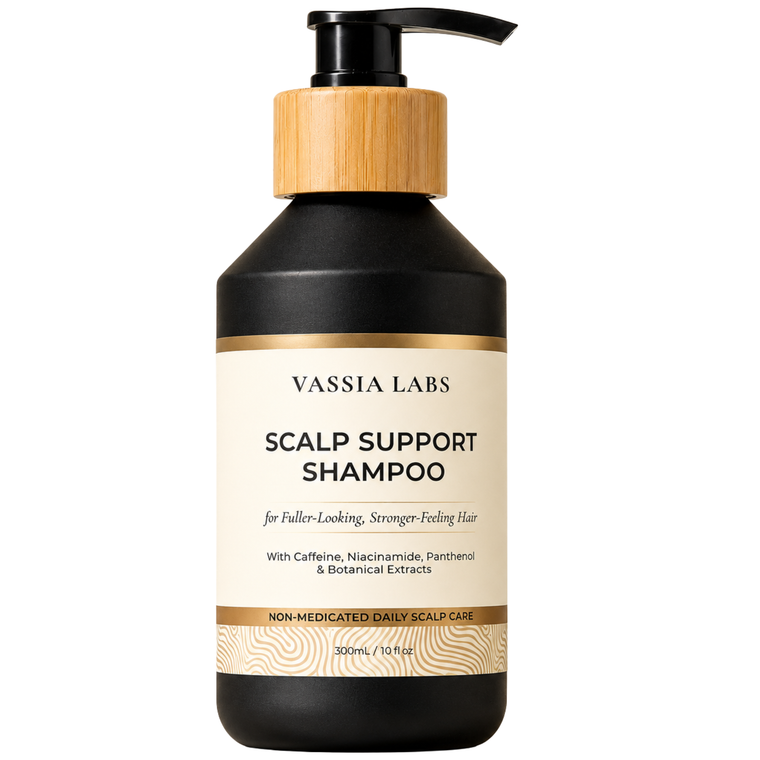
Vassia Labs Volumizing Shampoo for Fine, Flat & Thinning Hair is designed for fine hair that becomes weighed down easily while keeping scalp care part of the formula.
It is fragrance-free, sulfate-free and silicone-free. The formula combines caffeine, rosemary, niacinamide, panthenol, ginseng, aloe, centella, hyaluronic acid, zinc PCA, betaine, hydrolyzed wheat protein, vitamin E, biotin and chamomile.
The intended cosmetic result is cleaner, lighter roots, softer strands and fuller volume without a heavy coating.
Frequently asked questions
How do I pick a mild shampoo for an oily scalp and sensitive skin that gets red or feels like it is burning?
Start with a fragrance-free formula that still cleans your oil level effectively, use lukewarm water, rinse thoroughly and avoid adding several new scalp treatments at once. Repeated burning or redness is a reason to stop the suspected product and seek appropriate assessment if it persists.
Can a sensitive scalp still be oily?
Yes. Oil production and sensitivity are separate characteristics. A scalp can be oily while also reacting to fragrance, residue, water temperature or certain ingredients.
Should oily fine hair avoid moisturizing ingredients?
Not necessarily. Fine hair can still benefit from ingredients that support softness and manageability. The important issue is whether the complete formula leaves too much residual weight.
Why does my scalp feel oily but also tight?
Oiliness does not rule out irritation. Hot water, aggressive washing, residue or a poorly tolerated product can contribute. Persistent discomfort, redness or scaling deserves professional assessment.
Is fragrance-free shampoo better for sensitive scalps?
It can be useful because it removes added fragrance as a potential irritant, but no shampoo is guaranteed to suit every sensitive scalp.
Bottom line
Fine hair with oily roots and a sensitive scalp needs balance, not extremes. Clean enough to remove oil and buildup, remove unnecessary fragrance if sensitivity is a concern, condition the lengths strategically and judge the shampoo by how your scalp and roots behave after repeated normal use.
SUPPORTING GUIDE → COMMERCIAL COMPARISON → PRODUCT
Compare fragrance-free shampoos for fine, sensitive scalps
We compared Vassia Labs with SEEN and Vanicream on fragrance, scalp positioning, fine-hair volume and formula strategy.
See the fragrance-free shampoo comparison →