Conditioner can make fine hair look stringy when too much product is used, when it is applied too close to the roots, or when the formula is richer than the hair needs. Fine strands have less physical mass, so a small amount of excess coating can make them clump together instead of falling as separate, airy strands.
The goal is not to avoid conditioner. It is to use enough to reduce tangling and roughness without leaving the hair slick, coated or collapsed.
Why does conditioner make fine hair look stringy?
Stringiness usually happens when neighboring strands stick together in small sections. That can be caused by excess conditioner, heavy oils or butters, incomplete rinsing, or applying rich product directly at the roots.
When fine strands clump together, there are fewer visible groups of hair, so the lengths can look thinner even though the number of hairs has not changed.
Where should conditioner go on fine hair?
For most fine-hair routines, start through the mid-lengths and ends, where friction, tangling and weathering are usually greatest. If your roots flatten easily, there is rarely a cosmetic reason to coat the scalp with a rich conditioner.
Hair that is very dry, curly, chemically treated or unusually tangled may need more conditioning, so placement and amount should follow what the hair actually needs rather than a rigid rule.
How much conditioner should you use?
Use enough to lightly coat the mid-lengths and ends, then add a little more only where the hair still feels rough or tangles easily. The right amount depends on hair length, density and the formula. A universal “pea-size” rule is not useful for a chin-length bob and waist-length hair alike, despite the internet’s heroic commitment to measuring cosmetics with vegetables.
After distributing it, rinse thoroughly. If the lengths feel slick or look separated into heavy strings once dry, use less next time or move the product farther from the roots.
How to condition fine hair without losing volume
- Shampoo the scalp thoroughly. Remove oil and styling residue before adding conditioner.
- Apply conditioner below the roots. Start through the mid-lengths and ends.
- Use only enough to coat the hair lightly. Add more where needed rather than starting with a large amount.
- Detangle gently. Let the conditioner provide slip instead of pulling through knots aggressively.
- Rinse thoroughly. Residue can make fine strands clump and collapse.
- Judge the result over comparable wash days. One unusually oily, sweaty or product-heavy day is not a useful test of the routine.
What if your roots still look flat?
If the roots remain flat even when conditioner stays off the scalp, the issue may be oil, styling buildup, hard-water residue, or simply a shampoo that leaves too much behind. Read Why Does My Fine Hair Look Greasy So Fast? and the Complete Guide to Flat Hair & Root Volume for the next troubleshooting steps.
Where shampoo fits
A lightweight shampoo gives conditioner a cleaner starting point. Removing oil and product residue helps fine strands separate more evenly so the lengths do not have to fight through layers of buildup.
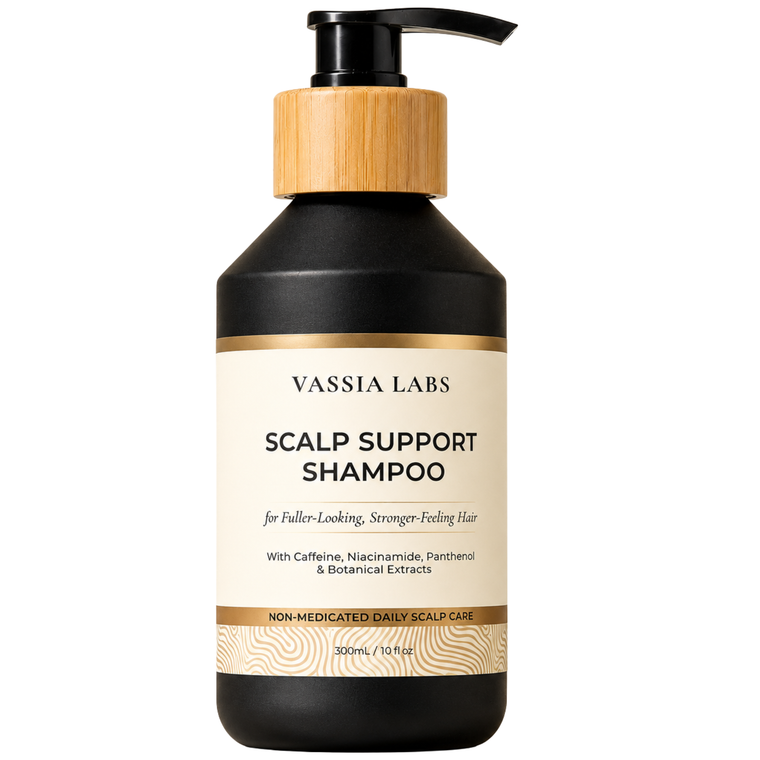
Vassia Labs Scalp Support Shampoo is a fragrance-free, sulfate-free and silicone-free cosmetic cleanser designed for fine, flat and thinning-looking hair. It is intended to cleanse without a heavy residue so roots can feel lighter and existing hair can look fuller.
Frequently asked questions
How much conditioner should I use on fine hair?
Use enough to lightly coat the lengths without leaving them slick or heavy. Start with a small amount, distribute it through the mid-lengths and ends, then add more only where needed.
Should fine hair skip conditioner?
Not necessarily. Conditioner can reduce tangling, friction and roughness. The better adjustment is usually using a lighter amount and keeping it away from roots that flatten easily.
Why does my hair look thinner after conditioner?
Heavy or excess conditioner can make fine strands clump into sections, exposing more space between them. That is a cosmetic change in separation, not proof that conditioner caused follicle loss.