There is no universal rule that fine hair needs clarifying shampoo every week, every month or on any fixed calendar. Clarify when ordinary cleansing is no longer removing stubborn product residue, oil or certain deposits, then reduce the frequency if the hair becomes rough or the scalp becomes irritated.
Regular vs clarifying vs chelating shampoo
| Type | Main job | When it may help |
|---|---|---|
| Regular shampoo | Routine removal of oil, sweat and everyday residue | Your normal wash days |
| Clarifying shampoo | Stronger removal of stubborn styling/product buildup | Hair still feels coated after normal washing |
| Chelating shampoo | Targets mineral/metal deposits with chelating ingredients | Hard-water or swimming-related deposits are the problem |
For the detailed distinction, read Clarifying vs Chelating vs Regular Shampoo.
Signs you may need a clarifying wash
- Roots remain waxy or coated after a normal wash.
- Dry shampoo, root powder, hairspray or styling products have been layered repeatedly.
- Fine hair loses movement quickly even when oil is not the main issue.
- Ordinary shampoo no longer leaves the scalp and roots feeling clean.
Persistent scale, redness, burning or scalp pain is different. Those symptoms can reflect a scalp condition and should not automatically be answered with a stronger cleanser.
How often should you clarify?
Use the least frequent schedule that solves the actual buildup problem. Someone who uses heavy styling products frequently may need a clarifier more often than someone with a minimal routine. Chemically treated, very dry or fragile hair may tolerate aggressive cleansing less well.
- Improve ordinary shampoo technique first.
- Use a clarifier when normal cleansing genuinely fails to remove residue.
- Concentrate shampoo on the scalp rather than scrubbing the full lengths.
- Condition the lengths afterward if they feel rough or tangle easily.
- Reduce frequency if dryness or irritation increases.
Commercial bridge: when an everyday shampoo is enough
If the problem is ordinary oil and day-to-day residue rather than stubborn buildup, you may not need a clarifier at all. The Complete Guide to Fine Hair explains how cleansing frequency, conditioner placement and styling residue interact.
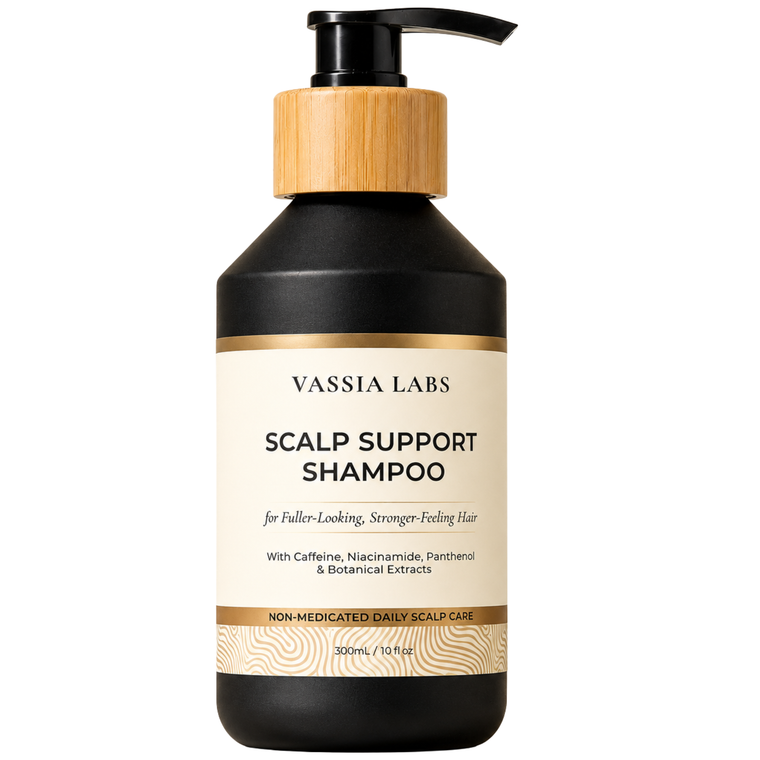
For routine scalp cleansing, Vassia Labs Scalp Support Shampoo is fragrance-free, sulfate-free and silicone-free and is designed for fine, flat and thinning-looking hair. It is an everyday cosmetic cleanser, not a medicated dandruff treatment or a substitute for a dedicated chelating formula when mineral deposits are the issue.
Frequently asked questions
Can I clarify every week?
Some people can tolerate that, but there is no reason to use a fixed weekly schedule if ordinary washing already leaves the hair clean and comfortable.
Is clarifying shampoo a dandruff treatment?
Not necessarily. Dandruff may require specific active ingredients or medical advice, while clarifying shampoos are primarily about residue removal.
Can clarifying shampoo remove hard-water minerals?
Some formulas contain chelating ingredients, but “clarifying” and “chelating” are not interchangeable terms. Check the formulation rather than relying on the front label.