Direct answer: regular shampoo is for routine scalp oil, sweat and everyday residue. Clarifying shampoo is generally formulated to remove heavier product buildup. Chelating products are designed to bind certain metal ions, making them more relevant to hard-water or pool-related mineral deposition.
Fine hair can encounter all three problems, but the solution should match the residue. Using a stronger shampoo for every problem is the hair-care equivalent of fixing every household issue with a hammer.
Regular vs clarifying vs chelating shampoo
| Shampoo type | Best for | What it targets | Fine-hair use |
|---|---|---|---|
| Regular lightweight shampoo | Routine washing | Scalp oil, sweat and everyday residue | Best default for most wash days |
| Clarifying shampoo | Heavier styling or dry-shampoo buildup | Accumulated oils, polymers and product residue | Use when ordinary washing stops being enough |
| Chelating shampoo | Hard-water or pool-metal deposits | Metal ions such as copper and mineral deposition | Target the mineral problem rather than simply cleansing harder |
What does regular shampoo remove?
Regular shampoo uses surfactants to loosen scalp oil, sweat, environmental soil and ordinary styling residue so they can be rinsed away.
For most wash days, this is all you need.
A well-matched regular shampoo should leave the scalp clean and comfortable while keeping the lengths manageable. Fine hair often benefits from a formula that does not leave a heavy conditioning film at the roots.
What is clarifying shampoo?
Clarifying shampoo is a consumer category rather than one standardized chemical formula. In general, these products are designed to clean more aggressively or remove a larger load of styling residue than an everyday cleanser.
Clarifying can be useful after:
- multiple dry-shampoo applications
- heavy texture spray or hairspray
- waxes or oils
- repeated leave-in layering
- a routine that leaves hair persistently coated despite normal washing
The exact strength varies by product, so “clarifying” on the label does not tell you everything.
What is chelating shampoo?
Chelating formulas contain ingredients that can bind metal ions. This makes them useful when the problem involves mineral or metal deposition rather than only organic oil and styling polymers.
Situations where chelation may be relevant include:
- hard-water exposure
- persistent mineral-feeling buildup
- swimming-pool exposure
- green discoloration associated with copper in light hair
A chelator is not simply “an extra-strong cleanser.” It performs a different chemical job.
Is hard-water buildup the same as product buildup?
No.
Hard water contains higher concentrations of dissolved calcium and magnesium. Product buildup usually refers to accumulated styling agents, oils, conditioners or dry shampoo.
The hair can experience both at once, which is why someone may clarify repeatedly without solving a metal-deposition problem.
Read Hard Water and Hair: What the Evidence Really Says.
Does swimming require chelating shampoo?
Not after every swim.
Occasional pool exposure may be handled with prompt rinsing and normal shampooing. Chelation becomes more relevant when there is evidence of metal buildup or discoloration.
Light hair turning green is classically associated with copper deposition. See Swimming With Fine Hair: Chlorine, Copper and Buildup.
How often should fine hair clarify?
There is no universal weekly or monthly schedule.
Clarify when your routine creates a level of residue that regular washing no longer removes adequately. Someone using dry shampoo daily may need it more often than someone using almost no styling products.
Fine hair can show buildup quickly, but it can also become rough if repeatedly over-cleansed. Use the result as feedback.
Our existing guide How Often Should You Use Clarifying Shampoo? covers frequency in more detail.
Signs you may need clarifying rather than more conditioner
- roots feel coated immediately after washing
- hair is dull or unusually difficult to style
- dry shampoo remains gritty near the scalp
- volume disappears because strands stay grouped together
- your normal shampoo no longer removes styling residue
If the problem started after rich conditioning, also read Can Fine Hair Be Over-Conditioned?.
Signs chelation may be the more relevant tool
- you live in a confirmed hard-water area
- hair feels coated despite minimal styling-product use
- light or bleached hair develops unusual mineral discoloration after pool exposure
- a water-quality issue corresponds closely with the change in hair feel
When uncertain, start with the least aggressive intervention that solves the actual problem.
Can a shampoo be both clarifying and chelating?
Yes. Product categories overlap. A formula may use strong cleansing surfactants plus chelating agents.
That is why reading the product's intended use and ingredient information is more useful than assuming every “detox” shampoo performs the same job.
Does sulfate-free mean a shampoo cannot clarify?
No.
Sulfate-free formulations can still cleanse strongly using other surfactants. Likewise, sulfate-containing shampoo is not automatically a dedicated clarifier.
Read Shampoo Surfactants Explained.
Where Vassia Labs fits
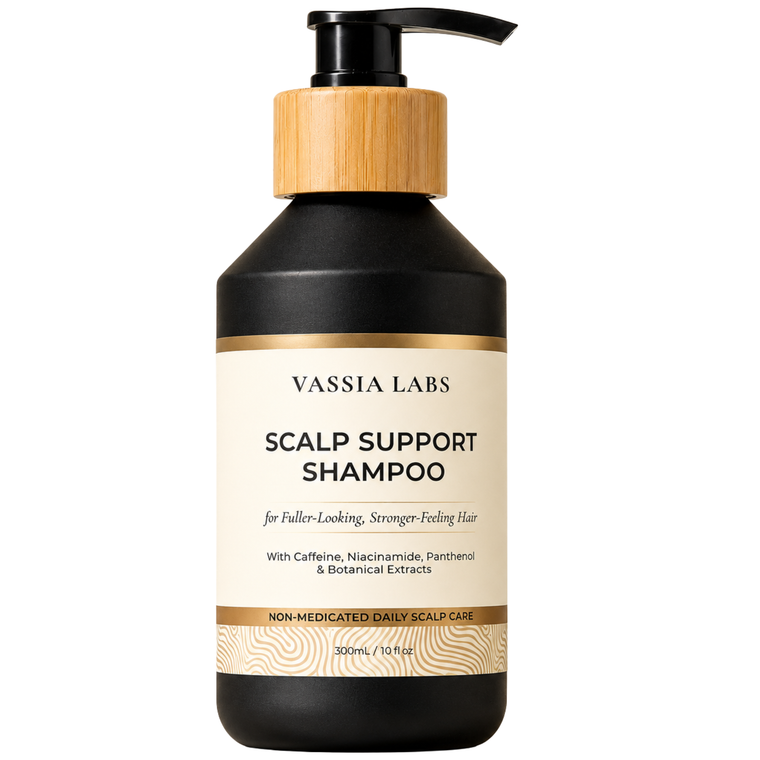
Vassia Labs Volumizing Shampoo is designed as a regular lightweight cosmetic cleanser for fine, flat and thinning-looking hair. It removes ordinary oil and everyday residue but is not positioned as an aggressive deep clarifier or specialized metal-chelating treatment.
That distinction is useful. Your everyday shampoo does not need to perform every specialized job on every wash day.
A simple decision tree
- Normal oil and everyday residue? Use your regular shampoo.
- Heavy styling, dry shampoo or oil buildup? Consider clarifying when normal washing is insufficient.
- Confirmed hard-water or pool-metal issue? A chelating product may be more targeted.
- Burning, rash, thick scale or persistent scalp symptoms? Stop treating it as a buildup puzzle and seek appropriate assessment.
Frequently asked questions
How often should you use clarifying shampoo?
Use it when buildup actually exceeds what your regular shampoo removes. Fine hair may reveal residue quickly, but there is no evidence-based rule that every person must clarify weekly.
Is clarifying shampoo the same as chelating shampoo?
No. Clarifying generally targets heavier residue; chelating specifically refers to binding metal ions. Some products do both.
Can fine hair use clarifying shampoo?
Yes, when buildup warrants it. Avoid using strong clarification more often than your hair actually needs.
Does hard water require a clarifying shampoo?
Clarifying may remove some associated residue, but chelation is more specifically targeted to metal ions.
Can chelating shampoo remove copper from pool exposure?
Chelating ingredients are used to bind metals, so a dedicated chelating formula is more relevant to copper deposition than simply increasing ordinary shampoo strength.
Is Vassia Labs a chelating shampoo?
No. It is a regular lightweight volumizing and scalp-support cleanser.
Sources and further reading
- A Review of Shampoo Surfactant Technology, PubMed
- Hard Water and Hair: What the Evidence Really Says
LEARN → COMPARE → SHOP
Ready to choose your everyday fine-hair shampoo?
Compare the strongest fine-hair options, then choose the formula that matches your roots, scalp and routine.
Compare Vassia Labs vs OUAI, Living Proof, Vegamour, Briogeo and Nioxin →

Fuller roots. More volume. Less breakage.
Vassia Labs is fragrance-free, sulfate-free and silicone-free, with caffeine, rosemary, niacinamide, panthenol and a lightweight formula built for fine, flat hair.