Direct answer: yes, fine hair can be over-conditioned in practice: too much conditioner, rich masks, oils or leave-in product can leave small-diameter strands coated, separated and flat. But that does not mean the hair has necessarily developed a mysterious medical condition called “moisture overload.”
Most of the time, the useful explanation is simpler: the amount, placement or richness of conditioning product is greater than your hair needs.
Quick diagnosis: what your fine hair is telling you
| What you notice | Likely routine issue | What to try |
|---|---|---|
| Soft but flat immediately after drying | Too much or too-rich conditioner | Use less and keep it lower on the hair |
| Stringy sections despite a clean scalp | Conditioner, oil or leave-in residue | Simplify the routine and rinse more thoroughly |
| Rough, tangly ends | Too little conditioning or weathered lengths | Condition the mid-lengths and ends rather than the roots |
| Roots collapse quickly but ends need softness | Different needs at scalp and lengths | Use a lightweight shampoo at the scalp and conditioner below |
Why does conditioning flatten fine hair?
Conditioners are designed to reduce friction, improve combability and smooth the hair surface. Those are useful jobs.
Fine strands, however, have less mass and are easily affected by added coating. A quantity that gives coarse hair beautiful slip can make fine hair look grouped together and heavy.
The problem is not that conditioner is “bad.” It is that dosage matters.
Signs your routine may be too conditioning-heavy
- roots look flat immediately after drying
- hair feels unusually slippery or coated
- strands separate into stringy sections
- volume disappears faster than usual
- hair looks greasy even though the scalp was just washed
- you are layering conditioner, mask, leave-in, oil and serum in the same routine
- hair improves when you temporarily reduce product amount
None of these signs proves permanent damage. They are clues that your current product load may be too heavy.
Is “moisture overload” a scientific diagnosis?
No.
The phrase is widely used online to describe hair that feels overly soft, limp or difficult to style after heavy conditioning. It can be a useful shorthand for a routine problem, but it should not be treated as a precise medical or structural diagnosis.
If hair is breaking, stretching abnormally or changing dramatically, look beyond internet labels. Chemical processing, heat, weathering, friction and underlying hair or scalp problems may be more relevant.
Should fine hair stop using conditioner?
Usually not.
The American Academy of Dermatology recommends conditioning after shampooing because conditioner can reduce friction and help protect hair. For fine or straight hair, concentrating conditioner toward the ends is often more appropriate than applying a rich layer at the roots.
Skipping conditioner entirely can make fragile lengths harder to detangle and increase mechanical stress.
Where should conditioner go?
If your roots flatten easily, begin at the ends and work upward only as far as the hair needs.
A simple placement rule:
- Scalp and first few centimeters: usually little or no ordinary conditioner unless the product specifically calls for scalp use.
- Mid-lengths: light application where tangling or roughness begins.
- Ends: typically the section that needs the most conditioning because it is oldest and most weathered.
For more detail, read Where Should You Apply Conditioner If Your Roots Go Flat?.
What if hair still feels coated after shampooing?
You may be dealing with product buildup rather than “too much moisture.”
Try simplifying the routine for several washes:
- Use one shampoo that cleans your scalp adequately.
- Rinse thoroughly.
- Use a smaller amount of lightweight conditioner on the lengths.
- Pause masks, oils and leave-ins temporarily.
- Reintroduce products one at a time.
If ordinary shampoo no longer removes accumulated styling residue, occasional clarifying can be useful.
Read Clarifying vs Chelating vs Regular Shampoo before reaching for the strongest bottle available.
Can protein fix over-conditioned hair?
Not automatically.
Protein-containing products can change the feel and body of damaged hair, but adding protein simply because hair feels limp can create a different mismatch. Judge products by the condition of your strands and the result, not a social-media moisture-versus-protein scoreboard.
Our Bond Repair vs Protein Treatment guide explains the distinction.
How to preserve volume after conditioning
- Use less product than you would on coarse hair.
- Apply from the ends upward.
- Rinse more thoroughly than feels theatrically necessary.
- Avoid stacking multiple rich products by default.
- Choose lighter leave-ins when you need extra slip.
- Dry the roots away from their natural resting direction for temporary lift.
For the full volume routine, read the Complete Guide to Flat Hair & Root Volume.
Where Vassia Labs fits
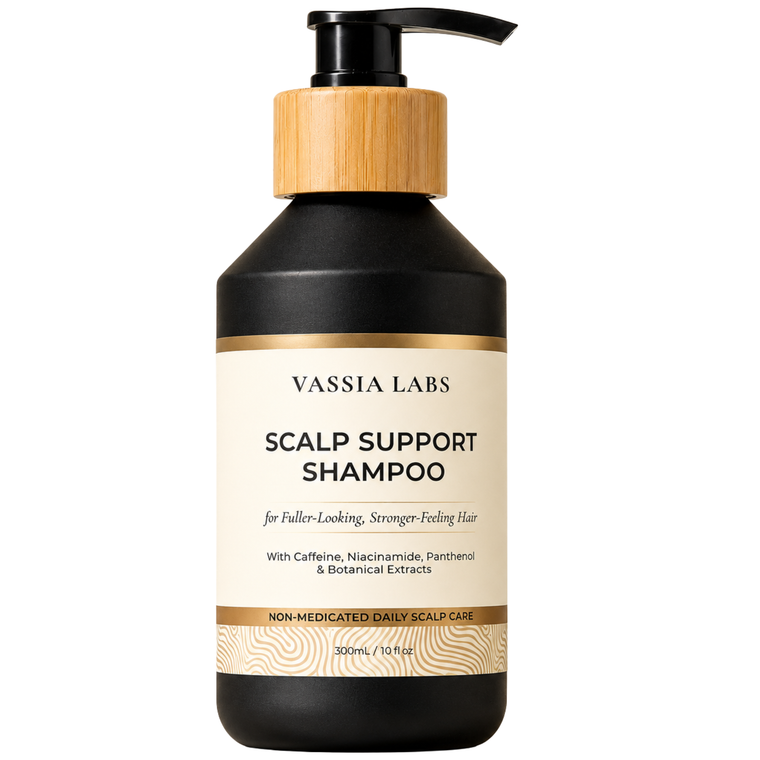
Vassia Labs Volumizing Shampoo is designed for fine hair that becomes heavy or flat easily. It is silicone-free and intended to cleanse oil and ordinary residue without deliberately leaving a dense root coating.
You can still use conditioner afterward. For very fine hair, keep that conditioner lightweight and concentrate it through the mid-lengths and ends.
Decision tree: should you change your conditioner or shampoo?
Roots are oily or coated? → Start with adequate scalp cleansing.
Roots are clean but lengths are limp? → Reduce conditioner amount or richness.
Ends tangle while roots flatten? → Keep shampoo at the scalp and conditioner on the lengths.
You want fuller roots without giving up softness? → Use a lightweight fine-hair shampoo such as Vassia, then condition strategically.
Frequently asked questions
Why does my hair feel soft but look flat?
Heavy conditioning, oil or product residue can make fine strands feel smooth while reducing separation and root lift.
Can too much conditioner make hair look greasy?
Yes. Residual conditioner can make strands group together and create a greasy appearance even when the scalp itself is clean.
How often should fine hair use a mask?
There is no universal schedule. Use a mask when the lengths benefit from it, and reduce frequency or amount if the hair repeatedly becomes limp or coated.
Should conditioner ever go on the scalp?
Only when the product is designed for scalp use or your specific routine calls for it. Ordinary rich conditioner usually works better on fine hair lengths than at the roots.
Does over-conditioning cause permanent hair damage?
Product heaviness and buildup are generally cosmetic and reversible with routine adjustment. Persistent breakage or major texture change may have other causes.
Sources and further reading
- Tips for Healthy Hair, American Academy of Dermatology
- Why Does Conditioner Make My Fine Hair Look Stringy?
LEARN → COMPARE → SHOP
Compare shampoos built for fine, flat hair
If heavy conditioning is stealing your volume, the shampoo underneath the routine matters too. Compare the leading fine-hair options before you buy.
See the best shampoo for fine thin hair comparison →

Fuller hair without the heavy finish.
Vassia Labs uses lightweight cleansing plus panthenol and hydrolyzed wheat protein to support fine, fragile strands without added fragrance, sulfates or silicones.