Direct answer: surfactants are the workhorse cleansing ingredients in shampoo. They help water interact with scalp oil, sweat and styling residue so that those materials can be dispersed and rinsed away. A shampoo being “sulfate-free” does not mean it cannot clean well, and it does not automatically prove that the formula is mild.
For fine hair, the useful question is not whether a shampoo contains one famous or unpopular surfactant. It is whether the complete cleansing system removes enough oil and buildup for your routine without leaving the scalp uncomfortable or the hair rough and tangled.
Shampoo surfactants at a glance
| Type | General role | What fine-hair shoppers should know |
|---|---|---|
| Anionic | Often strong cleansing and foam | Performance varies widely by molecule, concentration and blend |
| Amphoteric | Often paired with other surfactants to modify cleansing, foam and mildness | Common in balanced mixed systems |
| Nonionic | Can contribute cleansing with no formal ionic charge | Often used in mild or specialized systems |
| Sulfate-free blend | Uses alternatives to common sulfate surfactants | Can still clean oily fine hair effectively when the complete formula is well designed |
What is a surfactant?
A surfactant is a molecule with parts that interact differently with water and oil. This allows surfactants to help loosen oily material from the scalp and hair and keep it dispersed in rinse water.
That basic chemistry is why shampoo can remove sebum and styling residue much more effectively than water alone.
A review of shampoo surfactant technology describes surfactants as the core of shampoo formulation. They influence cleansing, foaming, texture, skin mildness and even how conditioning materials deposit onto hair.
Why do shampoos use more than one surfactant?
Because formulation is a balancing act.
One surfactant may provide strong cleansing or foam, while another may modify irritation potential, viscosity, rinse feel or compatibility with other ingredients. Commercial shampoos therefore often use blends rather than asking one molecule to perform every job humanity has assigned to a bottle in the shower.
Skin-barrier research also shows why mixtures matter. Studies of surfactant systems have found that co-surfactants and formulation structure can reduce some of the disruptive effects associated with stronger primary surfactants.
What are anionic, amphoteric and nonionic surfactants?
These categories describe electrical characteristics of the surfactant head group.
Anionic surfactants
Anionic surfactants carry a negative charge in use. They are often effective cleansers and can produce substantial foam. Sodium lauryl sulfate is a familiar example used frequently in irritation research, although actual shampoo formulas may use very different anionic surfactants and mixtures.
Amphoteric surfactants
Amphoteric surfactants can behave differently depending on pH and formulation environment. They are commonly combined with other surfactants to modify foam, cleansing and mildness.
Nonionic surfactants
Nonionic surfactants do not carry a formal ionic charge. They can contribute to cleansing and are frequently used in milder or specialized systems.
The category name alone still does not tell you exactly how a finished shampoo will behave.
Are sulfates bad for hair?
No blanket statement like that is scientifically useful.
“Sulfates” is a broad consumer shorthand that usually refers to surfactants such as sodium lauryl sulfate or sodium laureth sulfate. Some people find certain sulfate-containing formulas too cleansing or drying for their routine. Other people use them comfortably.
The irritation potential of a cleansing product depends on concentration, surfactant blend, pH, contact time, formulation structure and individual skin.
A sulfate-free formula can be mild, strong, excellent or poorly matched to you. The absence of one ingredient class is not a certificate of virtue.
Can sulfate-free shampoo clean oily fine hair?
Yes.
Sulfate-free shampoos use alternative surfactant systems. If the finished formula is designed appropriately, it can remove scalp oil and ordinary styling residue effectively.
This matters for fine hair because oil becomes visually obvious quickly when narrow strands group together. A cleanser that is too weak for your oil and product load can leave roots flat and separated. A cleanser that is unnecessarily aggressive may leave lengths rough and harder to manage.
The target is adequate cleansing, not ideological purity.
Does more foam mean a shampoo cleans better?
No.
Foam affects how shampoo spreads and how clean it feels to use, but lather volume is not a direct measurement of oil removal.
Oil, hard water, styling residue and formula design can all influence foam. A low-foam shampoo can cleanse effectively, while a mountain of bubbles can coexist with a formula that is wrong for your scalp.
Why can surfactants irritate skin?
Cleansing necessarily involves interaction with the skin surface. Research on skin cleansers shows that surfactants can extract components from the stratum corneum and some can remain in the outer skin after rinsing.
The amount of disruption varies substantially between surfactants and formulations. That is why modern mild-cleansing research focuses on reducing unnecessary surfactant interaction with skin rather than pretending cleansing can happen without chemistry touching anything.
For a sensitive scalp, read How to Support the Scalp Barrier Without Weighing Down Fine Hair.
What should fine hair look for?
Judge the finished result:
- Roots feel clean after drying.
- Oil is controlled for a reasonable period for your scalp.
- Hair separates rather than forming coated sections.
- The scalp does not repeatedly burn, sting or itch.
- Lengths remain manageable.
- You do not need an elaborate “detox” routine just to remove the shampoo itself.
If a shampoo gives you those outcomes, the surfactant system is doing its job.
Where pH fits
Surfactants and pH interact, but they are not the same thing. A shampoo can be sulfate-free and alkaline, or sulfate-containing and mildly acidic.
Read Shampoo pH for Fine Hair for the separate pH question.
Where Vassia Labs fits
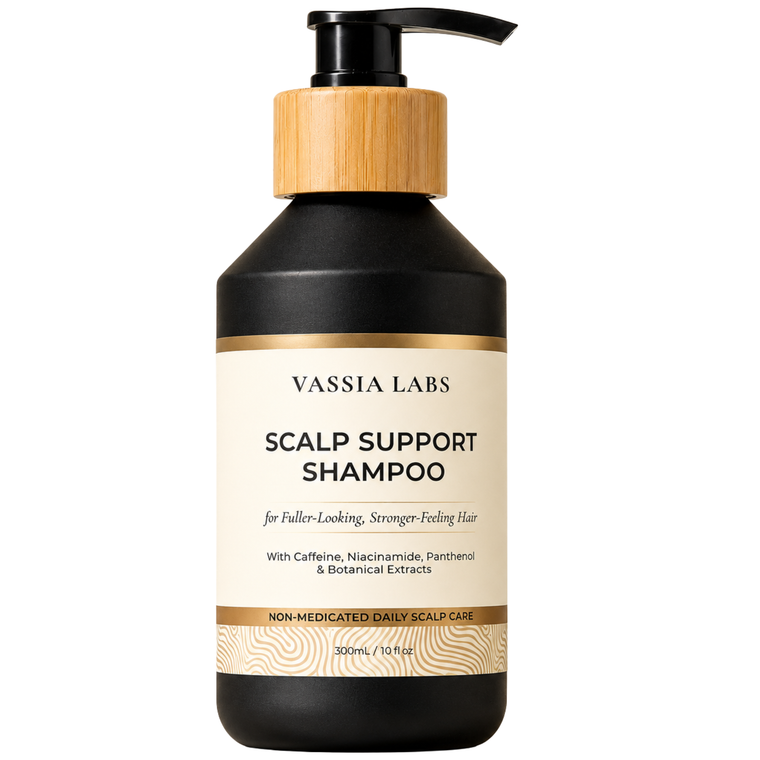
Vassia Labs Volumizing Shampoo uses a sulfate-free cleansing system designed for fine, flat and thinning-looking hair. The product goal is to remove excess oil and ordinary residue while preserving a soft, lightweight feel.
The formula is also fragrance-free and silicone-free. Those attributes may be useful for shoppers who prefer a simplified scalp routine or find very coating formulas too heavy for fine hair, but the most important test remains how the complete shampoo performs.
For the ingredient-level overview, see our Shampoo Ingredient Encyclopedia for Fine Hair.
Frequently asked questions
What is the main purpose of surfactants in shampoo?
They help loosen and disperse oil and residue so it can be rinsed away with water.
Is sulfate-free shampoo always gentler?
No. Mildness depends on the full surfactant system, concentration, pH, contact time and formulation.
Can shampoo clean without lots of lather?
Yes. Foam is not a direct measure of cleansing efficiency.
Should sensitive scalps avoid all anionic surfactants?
Not necessarily. Individual surfactants and complete formulations vary. Personal tolerance and the final product matter more than avoiding an entire chemistry category by name.
Can I identify a shampoo's strength from the ingredient list?
Only approximately. Ingredient order and surfactant names provide clues, but concentration, blends and formulation structure are not fully disclosed by the label.
Sources and further reading
- A Review of Shampoo Surfactant Technology, PubMed
- Cleansing Formulations That Respect Skin Barrier Integrity, PubMed
- Action of Surfactants on the Mammal Epidermal Skin Barrier, PubMed
LEARN → COMPARE → SHOP
See how the formulas compare in actual shampoos
Surfactant chemistry is useful, but the purchase decision happens at the finished-formula level. Compare leading fine-hair shampoos on cleansing, fragrance, scalp fit and value.
Compare the best shampoos for fine thin hair →