Direct answer: supporting the scalp barrier does not require avoiding shampoo, coating the scalp in oil or buying twelve products labelled “barrier repair.” The practical approach is to cleanse according to your scalp's actual oil and buildup, minimize repeated irritation, use comfortably warm rather than very hot water, rinse thoroughly and keep the routine simple enough to identify what your skin tolerates.
For fine hair, that can be done without sacrificing volume. The scalp and the hair lengths do not need identical products or identical amounts of conditioning.
Barrier support without flat roots: quick guide
| Need | Helpful approach | Common mistake |
|---|---|---|
| Clean oily fine roots | Use enough shampoo to remove oil and buildup | Stretching wash day while the scalp stays greasy |
| Reduce avoidable irritation | Fragrance-free products, lukewarm water, gentle fingertip washing | Stacking scrubs, acids and scented scalp products |
| Keep fine hair full | Condition mainly through mid-lengths and ends | Using rich oils or conditioner at the crown |
| Understand persistent burning or rash | Stop suspect products and seek appropriate assessment | Treating ongoing inflammation as ordinary “dryness” |
What is the scalp barrier?
The scalp is skin. Its outermost layer, the stratum corneum, helps limit water loss and protects against environmental and chemical exposure.
Cleansing is necessary, but surfactants interact with that outer layer while removing oil and residue. Research on skin cleansers shows that formulation design can influence how disruptive those interactions are.
This does not make shampoo an enemy. Oil, sweat and product buildup also need to be removed. The goal is appropriate cleansing rather than maximal cleansing or maximal avoidance.
What can make a scalp feel “stripped”?
Common contributors include:
- a cleanser that is too aggressive for your frequency of use
- very hot water
- scratching with fingernails
- frequent exfoliating scrubs or acids
- leaving shampoo residue behind
- fragrance or another ingredient you personally react to
- using several new scalp products at once
- a medical scalp condition being mistaken for ordinary dryness
Tightness after washing is a symptom, not a diagnosis. Persistent itching, rash, scale, pain, sores or hair loss deserves more careful assessment.
Do you need to wash less often?
Not automatically.
The American Academy of Dermatology recommends washing based on how quickly the scalp becomes oily or dirty. Someone with straight, oily hair may need frequent washing. Someone with a drier scalp or textured hair may need less.
Fine hair often shows oil quickly because narrow strands group together when coated. Stretching wash day beyond your scalp's comfort can therefore create more oil, residue and flatness without providing a proven “barrier reset.”
Use the mildest routine that still cleans effectively at the frequency you need.
Why rinse quality matters
Residual shampoo can irritate skin, and residual conditioner or styling product can make fine roots feel coated.
During rinsing, pay attention to the crown, nape, hairline and areas behind the ears. Move hair gently so water reaches the scalp rather than flowing only over the outer layer of hair.
This is remarkably unglamorous advice, which is probably why social media prefers inventing scalp detoxes.
Does fragrance matter?
Fragrance is optional in shampoo. Most people tolerate fragranced products, but fragrance is a recognized trigger for allergic contact dermatitis in susceptible individuals.
If your scalp repeatedly reacts to scented hair care, choosing fragrance-free products removes one variable. “Fragrance-free” is more useful than “unscented” when fragrance avoidance is the goal because unscented products can still use masking fragrance.
Read our Complete Sensitive Scalp Shampoo Guide for a broader comparison.
What about sulfate-free shampoo?
Some people find sulfate-free formulas more comfortable, but sulfate-free is not synonymous with non-irritating.
Every shampoo needs a cleansing system. Alternative surfactants can also be too strong, too weak or poorly tolerated depending on the formulation and person.
For the chemistry without the ingredient panic, read Shampoo Surfactants Explained.
Should you put oil on a dry or tight scalp?
Not automatically.
Oil can reduce friction or provide an occlusive feel, but it can also flatten fine roots, complicate buildup and be poorly suited to some oily or flaky scalp conditions. A tight scalp after shampooing does not prove that the scalp lacks oil.
If symptoms are persistent, identify the cause before adding increasingly rich products.
Do scalp scrubs repair the barrier?
No.
Physical exfoliation can remove scale or residue in some circumstances, but rough or frequent scrubbing can increase irritation. An already burning, inflamed or cracked scalp is a particularly poor candidate for enthusiastic exfoliation.
If scale is substantial or recurring, it may require a medicated approach rather than more friction.
How to build a barrier-conscious routine for fine hair
- Wash according to oil and buildup. Do not force a universal wash schedule.
- Use lukewarm water. Avoid prolonged very hot rinsing.
- Focus shampoo at the scalp. Let lather run through the lengths during rinsing.
- Use fingertips, not nails. Cleaning does not require scratching.
- Rinse thoroughly. Residue defeats the purpose of a comfortable routine.
- Condition strategically. Fine hair usually benefits from conditioner mainly through the mid-lengths and ends.
- Introduce one new scalp product at a time. Otherwise you learn nothing when the scalp objects.
- Stop products that repeatedly cause burning, rash or swelling.
Where Vassia Labs fits
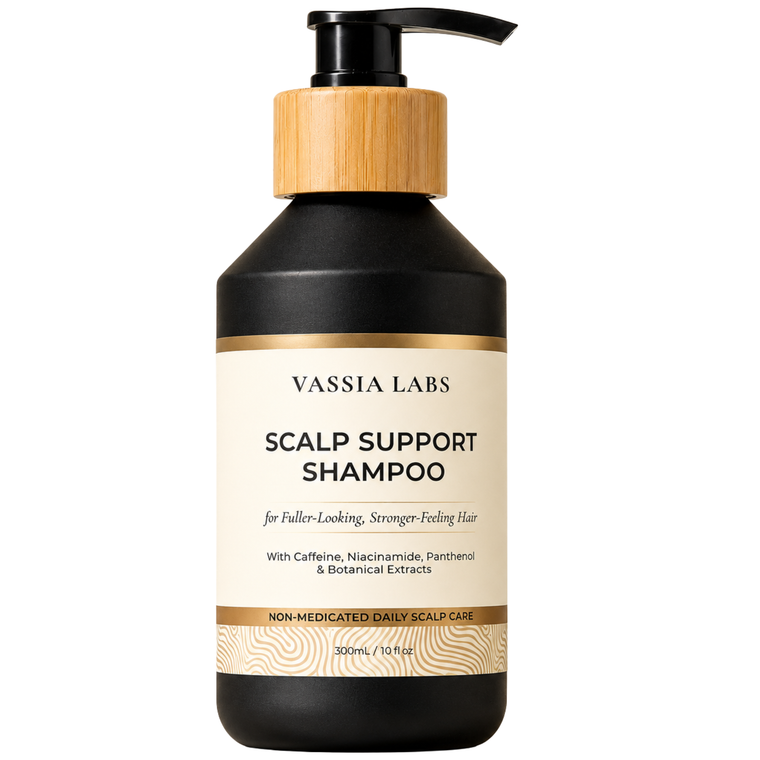
Vassia Labs Volumizing Shampoo is a fragrance-free, sulfate-free and silicone-free cosmetic shampoo for fine, flat and thinning-looking hair. It is designed for regular scalp-focused cleansing without a deliberately heavy root coating.
Its formula includes niacinamide, zinc PCA, aloe, centella, panthenol, betaine and hyaluronic acid alongside caffeine, rosemary and other scalp and strand-support ingredients. The goal is cleaner roots, a comfortable scalp routine and fuller fine hair.
It is not a treatment for eczema, psoriasis, seborrheic dermatitis, allergic contact dermatitis or another medical scalp condition.
If your main goal is lightweight volume as well as scalp comfort, see the Complete Guide to Fine Hair.
When to get professional advice
Seek appropriate assessment for persistent or worsening burning, severe itching, visible rash, thick scale, open sores, pustules, pain, patchy hair loss, a progressively widening part or symptoms extending onto the face, ears or neck.
A damaged or inflamed scalp is not something a cosmetic article can diagnose from across the internet, despite the confidence with which the internet enjoys trying.
Frequently asked questions
How do I pick a mild shampoo for an oily scalp and sensitive skin that gets red or burns?
Choose a formula that still removes your normal oil load, remove added fragrance as an avoidable variable, rinse thoroughly and stop products that repeatedly cause burning. Persistent redness or burning deserves assessment rather than endlessly switching cosmetic products.
Can washing every day damage the scalp barrier?
Frequency alone does not determine damage. The cleanser, technique, scalp oiliness and individual tolerance matter. Some oily scalps may need daily cleansing.
Is scalp tightness always dryness?
No. It can also occur with irritation, residue, hot water, contact dermatitis or another scalp condition.
Does a healthy scalp need oil applied to it?
No universal oil application is required. Use products according to your scalp's actual needs.
Is fragrance-free shampoo better for everyone?
No. It is most useful for people who prefer fragrance-free products or are trying to remove fragrance as a potential irritant.
Can shampoo repair eczema?
A cosmetic shampoo should not be presented as treatment for eczema or other diagnosed skin disease.
Sources and further reading
- Cleansing Formulations That Respect Skin Barrier Integrity, PubMed
- Action of Surfactants on the Mammal Epidermal Skin Barrier, PubMed
- Tips for Healthy Hair, American Academy of Dermatology
LEARN → COMPARE → SHOP
Compare fragrance-free shampoos before you buy
For fine hair, “gentle” is not enough if the roots stay flat. Compare fragrance-free formulas on both scalp fit and volume.
Compare Vassia Labs vs SEEN vs Vanicream →