Direct answer: shampoo pH can affect how the hair fiber behaves, but a “pH-balanced” label does not prove that a shampoo is gentle, effective or ideal for fine hair. Research suggests that more alkaline shampoo can increase negative electrical charge and friction at the hair surface, while lower-pH formulas may reduce static and frizz. There is still no universally established “perfect” shampoo pH for every scalp and hair type.
For fine hair, the practical priority is a formula that cleans the scalp properly, rinses without a heavy coating and leaves the hair comfortable and manageable. pH is one formulation detail, not a shopping shortcut.
What shampoo pH can and cannot tell you
| Claim or question | Useful interpretation |
|---|---|
| “pH-balanced” | Too vague by itself unless the brand gives a tested finished-product range |
| Higher alkaline pH | May increase hair-fiber surface charge and friction |
| Lower / mildly acidic pH | May help reduce static and friction, but does not guarantee a good shampoo |
| Fine-hair shopping decision | Judge cleansing, residue, scalp comfort and finished hair feel alongside pH |
What does shampoo pH mean?
pH describes how acidic or alkaline a water-based solution is. A value of 7 is neutral; values below 7 are acidic and values above 7 are alkaline.
Hair-care products are often described as “pH-balanced,” but that phrase is frustratingly vague. Balanced to what, exactly? The scalp, the hair fiber, the eyes, the preservation system, or a marketing department with a label printer?
A 2014 review that measured 123 commercial shampoos found products spanning approximately pH 3.5 to 9.0. The authors concluded that alkaline pH may increase surface charge and fiber-to-fiber friction, which could contribute to cuticle damage and breakage. They also noted that no standardized ideal final pH had been established.
Why can alkaline shampoo increase friction?
The outside of a hair strand is covered by overlapping cuticle cells. The way those surfaces interact affects friction, static, tangling and how rough or smooth hair feels.
According to the published review, increasing alkalinity can increase negative electrical charge on the fiber surface. That can increase repulsion and friction between strands. For hair that is already fragile, bleached, weathered or fine, unnecessary friction is not especially helpful.
This does not mean every shampoo above pH 5.5 is damaging or every acidic formula is excellent. The study itself called for more research, and real products contain surfactants, conditioning agents, polymers, salts, preservatives and other ingredients that change performance.
Does lower pH “close the cuticle”?
That phrase is too simplistic.
Hair cuticle behavior is influenced by water, chemical processing, heat, friction and formulation conditions. A lower-pH rinse can affect swelling and surface charge, but hair does not behave like a door that is either fully open or fully closed.
A better way to think about pH is that it can influence the physical environment around the hair fiber. It is one reason very alkaline chemical treatments behave differently from ordinary shampoo. It is not a magic switch.
Does fine hair need a special shampoo pH?
There is no strong evidence establishing one exact pH that all fine hair “needs.”
Fine hair has a smaller strand diameter, so it can be more visibly affected by oil, residue, heavy conditioning and mechanical damage. That makes the overall wash result more important than chasing a number on a label.
For fine hair, ask:
- Does the shampoo remove normal oil and styling residue?
- Does it rinse cleanly?
- Do the roots feel light rather than coated?
- Does the scalp remain comfortable?
- Do the lengths feel manageable rather than rough?
- Can you use it at the frequency your scalp actually needs?
Those questions will usually tell you more than a standalone “pH-balanced” claim.
What about sensitive scalps?
Skin-barrier research suggests that cleanser pH can interact with surfactant effects, but sensitivity cannot be predicted by pH alone. Fragrance, preservatives, the surfactant system, rinse quality and personal allergies can all matter.
If your scalp regularly burns, stings, itches or develops a rash after shampooing, do not assume the answer is simply “lower pH.” Review the whole routine and see our complete sensitive-scalp shampoo guide.
Should shampoo brands publish pH?
It can be useful information, but only when the value comes from reliable testing of the finished product. Ingredient lists do not let a consumer calculate the final pH accurately.
Likewise, a brand stating “pH-balanced” without giving a range tells you relatively little. It may still be a perfectly good shampoo. The label just does not deserve the scientific authority people often assign to it.
pH versus surfactants: which matters more?
Both can matter, but they describe different things.
pH describes acidity or alkalinity. Surfactants are the cleansing ingredients that help water remove oil and residue. The finished surfactant system has a major effect on cleansing strength, foam, residue and skin interaction.
Read Shampoo Surfactants Explained for the part of the ingredient list that actually does most of the washing.
Where Vassia Labs fits
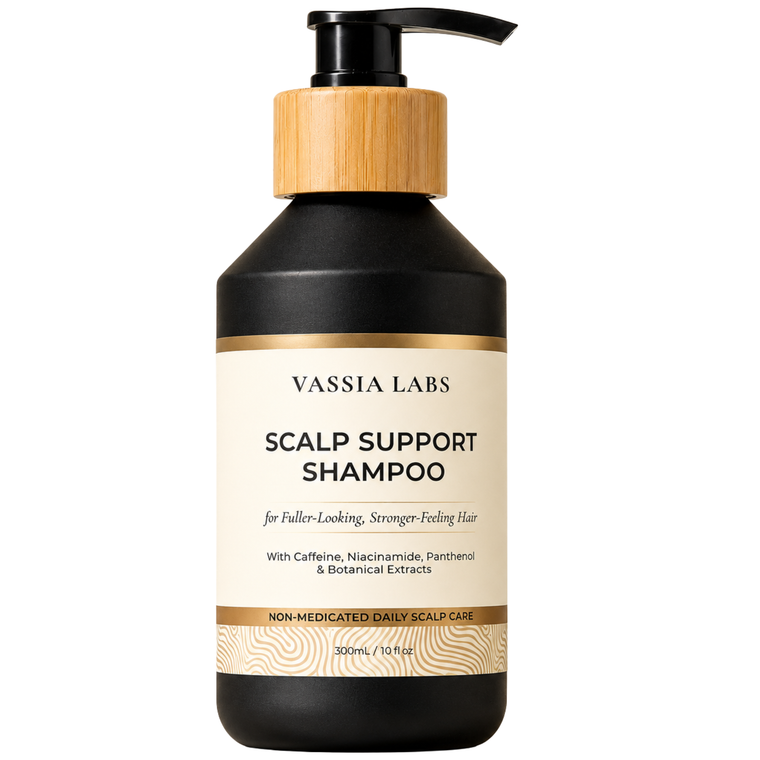
Vassia Labs Volumizing Shampoo is formulated for fine, flat and thinning-looking hair with a fragrance-free, sulfate-free and silicone-free cleansing system.
We do not present an unverified pH number as a reason to buy it. The practical product goals are lightweight cleansing, scalp-focused washing, manageable softness and fuller volume without a heavy root coating.
For a broader routine, see the Complete Guide to Fine Hair.
Frequently asked questions
What pH should shampoo be?
There is no universally standardized ideal shampoo pH for every person. Research suggests avoiding unnecessarily alkaline formulas may be beneficial for hair-fiber friction, but complete formulation and scalp tolerance still matter.
Is pH 5.5 automatically best for hair?
No. Skin is often discussed around a mildly acidic pH, but hair products have different formulation requirements. A single number cannot establish overall product quality.
Can alkaline shampoo cause frizz?
Higher pH may increase negative electrical charge and fiber friction, which can contribute to static and roughness. The visible result still depends on the full formula and the condition of the hair.
Can I tell shampoo pH from the ingredient list?
No. The finished product must be measured. Ingredients alone do not reveal the final pH reliably.
Does sulfate-free mean low pH?
No. “Sulfate-free” describes the surfactant choice, not the final pH.
Sources and further reading
- The Shampoo pH Can Affect the Hair: Myth or Reality? PubMed
- Tips for Healthy Hair, American Academy of Dermatology
LEARN → COMPARE → SHOP
Compare finished formulas, not one label claim
pH matters, but the better purchase decision is based on the full formula. Compare leading fine-hair shampoos on cleansing, scalp fit, fragrance, ingredients and value.
Compare the best shampoos for fine thin hair →