There is no universal amount of shampoo that is right for every person with fine hair. Start with the amount recommended on your shampoo’s label, or the smallest amount that gives even coverage across a thoroughly wet scalp, then adjust based on formula concentration, scalp area, oil and product buildup, and how easily the shampoo distributes.
The useful target is not a pea, coin, pump count or dramatic mountain of foam. It is enough cleanser to reach the scalp evenly and rinse away the oil and residue that actually need removing.
Why there is no universal shampoo amount
Shampoos vary substantially in concentration, surfactant system, pump output and directions. Scalp size, hair density, oil production, styling products and dry-shampoo use also vary from person to person. A fixed coin-size rule can therefore be too little for one routine and wasteful for another.
The American Academy of Dermatology recommends focusing shampoo on the scalp, where oil, dead skin and product buildup collect, rather than routinely scrubbing shampoo through the full length of the hair.
What changes how much shampoo you need?
- Formula concentration: Follow the label first. A concentrated shampoo may require less than a more dilute formula.
- Scalp area and hair density: The goal is even scalp coverage. Dense hair can make distribution harder even when individual strands are fine.
- Oil and product buildup: Dry shampoo, hairspray, root powders and heavier styling products can increase cleansing demand.
- How wet the scalp is: Thorough saturation helps shampoo spread more evenly and can reduce unnecessary product use.
- Distribution: Applying everything to one spot often creates the illusion that more shampoo is needed when the real problem is uneven placement.
How to find the right amount for your fine hair
- Wet the scalp thoroughly. Let water reach the crown, sides, hairline and nape before applying cleanser.
- Start with the label directions or a modest amount. You can add more if coverage is incomplete, but excess product is harder to take back once it is on your head.
- Distribute it across several scalp areas. Place small amounts around the hairline, crown, sides and back rather than depositing the full amount in one location.
- Massage gently with fingertips. Focus cleansing on the scalp and avoid scratching with fingernails or roughing up fragile lengths.
- Rinse thoroughly. Residue left behind can make fine roots feel coated and can contribute to itch or flatness.
- Assess the result. If the scalp feels clean and comfortable and the roots are not coated, you used enough. If obvious oil or residue remains, improve distribution or use a small second cleanse when appropriate.
Is a second cleanse better than using a huge amount once?
Sometimes. After heavy oil, several dry-shampoo applications or substantial styling-product buildup, two smaller cleanses may distribute more effectively than one oversized application.
A second cleanse is not automatically necessary. If one application leaves the scalp clean and comfortable, repeating it simply because social media declared “double shampooing” a ritual is not evidence-based hair care.
Does more foam mean cleaner hair?
No. Foam is influenced by the formula, water, oil and product residue. A low-foam first wash does not automatically mean the shampoo failed, and a large amount of lather does not prove that the scalp is cleaner.
Judge the result by scalp cleanliness, comfort, residue and how the roots feel after rinsing rather than by bubble volume.
Do you need more shampoo if your fine hair is long?
Usually not simply because of length. Shampoo is primarily used to cleanse the scalp. Longer hair may change how much conditioner or leave-in product the lengths need, but it does not automatically mean the scalp requires a larger shampoo dose.
If long or dense hair makes it difficult to reach the scalp, sectioning the hair and improving distribution is often more useful than pouring more shampoo onto the top of the head.
What if your roots are oily but your ends are dry?
Treat the scalp and lengths as different zones. Cleanse the scalp according to its oil and buildup, then condition the mid-lengths and ends according to their dryness and damage. This allows fine roots to be cleaned without unnecessarily scrubbing already-fragile ends.
Where a lightweight shampoo fits
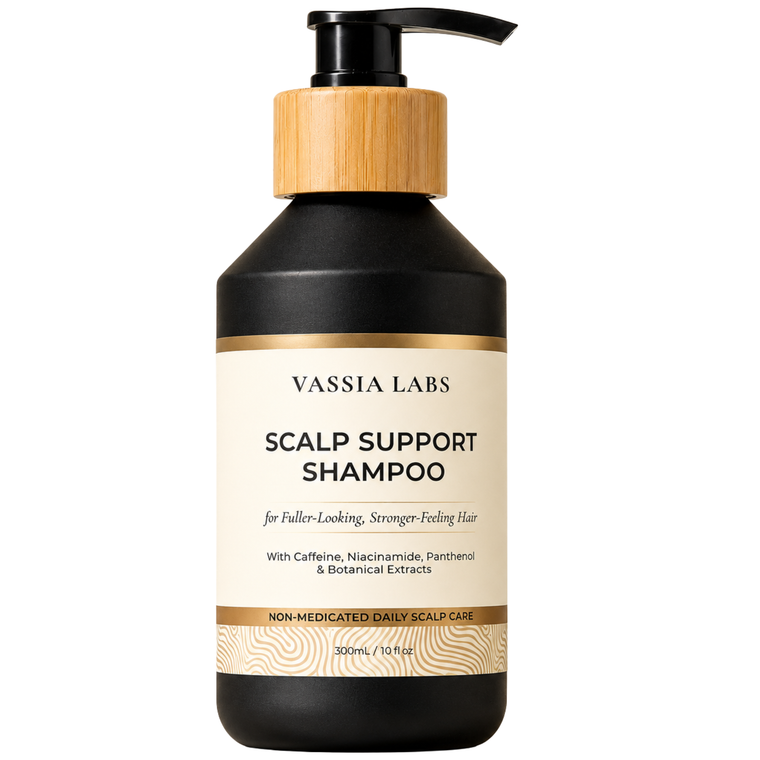
If you want a fragrance-free, sulfate-free and silicone-free cleanser designed for fine, flat or thinning-looking hair, Vassia Labs Scalp Support Shampoo is formulated to cleanse the scalp and leave roots feeling lighter without a heavy silicone-coated finish. It includes niacinamide, caffeine, rosemary extract and panthenol as part of the overall cosmetic formula.
Its role is scalp cleansing and cosmetic support. Shampoo cannot diagnose or treat the underlying causes of progressive hair loss.
When to get professional advice
Persistent itching, pain, burning, thick scale, sores, sudden shedding or progressive thinning should not be managed by simply changing the amount of shampoo. A board-certified dermatologist can evaluate whether a scalp or hair-loss condition needs treatment.
Related guides
- The Complete Guide to Fine Hair
- How Often Should You Use Clarifying Shampoo?
- How to Dry Fine Hair With Less Breakage
- How to Wash Fine Hair After a Workout
Frequently asked questions
Is one pump of shampoo enough for fine hair?
It may be. Pump sizes and formula concentrations differ, so one pump is not a universal measurement. Use the label directions and judge whether the amount gives even scalp coverage and rinses cleanly.
Should I use more shampoo because my hair is long?
Not automatically. Scalp area, oil, buildup and distribution usually matter more than hair length for shampoo quantity.
Why does the first wash sometimes produce very little foam?
Oil, styling residue, water conditions and the formula itself can affect lather. Foam is not a reliable measure of cleansing performance.
Do I need to shampoo twice?
Only when one cleanse does not adequately remove heavy oil or product buildup. If one application leaves the scalp clean and comfortable, a second is unnecessary.