Hair thinning has been reported by some people using GLP-1 medications, but the reason is not fully settled. The American Academy of Dermatology (AAD) says dermatologists believe rapid weight loss is likely an important contributor in many cases because substantial weight loss can trigger temporary excessive shedding, often called telogen effluvium. Reduced food intake may also contribute for some people, while a direct medication effect has not been ruled out.
That distinction matters. It is more accurate to say that hair thinning can occur during GLP-1 treatment than to claim the medication is definitely damaging follicles or that every case is caused only by weight loss.
What do dermatologists currently think?
In updated 2026 guidance, the AAD notes that thinning hair has been reported with GLP-1 drugs. Dermatologists suspect that sudden weight loss can trigger telogen effluvium, a temporary shift in the hair cycle that causes more hairs to shed. Eating substantially less during treatment may also make adequate nutrition harder for some people.
The AAD also says more research is needed. A direct drug effect remains possible, so the current evidence does not justify treating the mechanism as completely settled.
What does temporary excessive shedding look like?
Telogen effluvium usually causes diffuse shedding rather than one smooth bald patch. The increase can become noticeable a few months after a major trigger because of the timing of the hair cycle.
You may see more full-length hairs during washing or brushing and temporary loss of overall fullness. That is different from breakage, which produces shorter snapped pieces, and from progressive patterned loss, which can show up as a widening part or steadily smaller ponytail.
What should you do if you notice more shedding?
- Do not stop or change a GLP-1 medication on your own. Discuss the change with the clinician who prescribes it.
- Tell your clinician about the timeline. Note when treatment began, how quickly weight changed, when shedding started and whether your food intake became substantially more restricted.
- Do not guess at deficiencies. If nutritional intake is a concern, a qualified healthcare professional can decide whether dietary review or testing is appropriate.
- Protect the hair shaft. Reduce unnecessary heat, bleach, tight styles and aggressive detangling while fullness is reduced.
- Track density consistently. Monthly photographs of the part and crown are more useful than counting every loose strand.
Could it be something other than the GLP-1?
Yes. Female-pattern hair loss, thyroid disease, nutritional issues, illness, major stress, postpartum shedding, other medication changes and scalp conditions can overlap with GLP-1 treatment. A medication can be part of the timeline without automatically being the sole cause.
A progressive widening part, smooth patches or significant scalp symptoms are reasons to look beyond a simple temporary-shedding explanation.
Where shampoo fits
A cosmetic shampoo can remove oil and styling residue, help fine strands separate at the roots and make existing hair look fuller. It cannot prevent or treat telogen effluvium, correct a nutritional deficiency or determine whether a medication is responsible for hair loss.
The Complete Guide to Thinning-Looking & Fragile Hair explains how to distinguish shedding, breakage, cosmetic flatness and progressive density change.
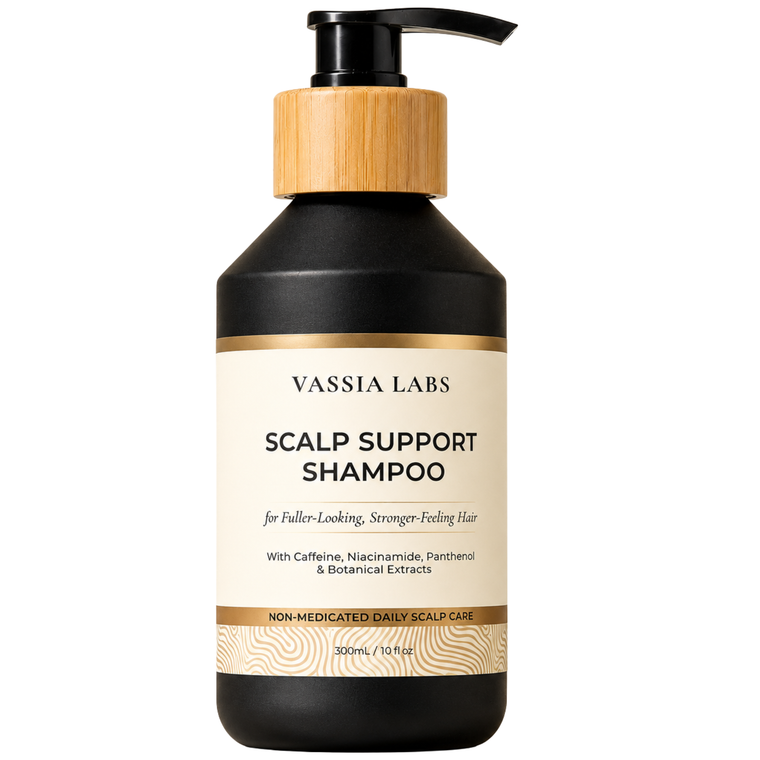
Vassia Labs Scalp Support Shampoo is a non-medicated, fragrance-free, sulfate-free and silicone-free cleanser for fine, flat and thinning-looking hair. It can support lightweight cleansing and fuller-looking wash days; it is not a treatment for medication-related hair loss.
When should you see a dermatologist?
Arrange professional assessment for persistent or worsening heavy shedding, a progressively widening part, a clearly smaller ponytail, smooth patches, scalp pain or burning, heavy scale, sores, scarring or another unexplained change in density. Your dermatologist and prescribing clinician can each address different parts of the picture.
Frequently asked questions
Do GLP-1 medications definitely cause hair loss?
No. Hair thinning has been reported, but the mechanism is not settled. The AAD says rapid weight loss is likely an important contributor in many cases and that more research is needed.
Can reduced food intake matter?
It may. The AAD notes that eating less while using a GLP-1 can make it harder for some people to get enough nutrients. That does not mean everyone who sheds has a deficiency.
Should I stop my GLP-1 if my hair sheds?
Do not change a prescription medication without discussing it with the clinician who manages your treatment.
Can volumizing shampoo help?
It can improve the appearance of existing fine hair by removing residue and supporting root lift. It does not treat the underlying cause of medical hair shedding.