Herbal shampoo is having a very 2026 moment.
Rosemary, ginseng, turmeric, plant proteins and long botanical ingredient lists are showing up across prestige, K-beauty and mass-market hair care. The appeal is understandable: consumers want formulas that feel purposeful, scalp-aware and less dependent on fragrance and cosmetic coating.
But a shampoo does not become better merely because the ingredient list resembles a greenhouse inventory.
Here is how to judge botanical shampoo without dismissing useful plant ingredients or accepting every plant-based claim at face value.
Why herbal shampoos are growing
Hair care is becoming more ingredient-led. Beauty shoppers increasingly inspect labels, research actives and expect brands to explain what each ingredient is supposed to do.
That shift has pushed rosemary and other botanicals into the spotlight, especially in scalp-care and thinning-hair categories.
The trend is not inherently bad. It is actually an improvement when consumers ask better questions. The problem starts when “contains rosemary” quietly becomes “therefore this shampoo regrows hair.”
Rule 1: Judge the cleansing system first
Shampoo is first a cleanser.
If a formula cannot remove the amount of oil, sweat and styling residue you actually accumulate, an impressive botanical blend will not rescue it.
For fine hair, poor cleansing can be especially visible because residue groups strands together and makes roots appear flatter.
On the other hand, overly aggressive cleansing can leave the scalp uncomfortable and the hair rough. The target is not maximum stripping. It is appropriate cleansing.
Rule 2: “Natural” does not mean irritation-proof
Plants contain active chemical compounds. That is partly why they are interesting.
It is also why “botanical” cannot be used as a synonym for universally gentle.
Essential oils, plant extracts and fragrance components can irritate or trigger allergy in susceptible people. If your scalp is sensitive, added fragrance and highly aromatic essential-oil blends deserve the same scrutiny as any other cosmetic ingredient.
A simple fragrance-free formula may be a better choice than a “natural” shampoo whose main sensory experience is a botanical perfume cloud.
Rule 3: Look at the format of the evidence
Rosemary is a good example.
A randomized comparative trial found increased hair counts after six months in participants using rosemary oil and in participants using 2% minoxidil. That makes rosemary interesting.
It does not establish that any rosemary extract added to any rinse-off shampoo will produce the same result.
The study product, dose, vehicle, frequency and contact time matter. Evidence on one preparation belongs to that preparation until other research shows otherwise.
The same caution applies to ginseng, saw palmetto and almost every trending botanical used in hair care.
Rule 4: Do not ignore the “boring” ingredients
Consumers naturally gravitate toward hero ingredients because “rosemary” sounds more exciting than “conditioning polymer.”
Yet the less glamorous parts of a formula often determine whether you enjoy using it.
For fine hair, useful supporting ingredients may include:
- mild surfactants that remove oil and residue
- panthenol for conditioning and improved strand feel
- hydrolyzed proteins for temporary body and manageability
- humectants that support hydration without heavy oils
- conditioning agents that reduce roughness and tangling
A strong shampoo formula is a system, not a hero-ingredient talent show.
Rule 5: Ask what the claim actually means
Botanical hair care often uses phrases such as “supports growth,” “strengthens roots,” “detoxes follicles” or “blocks DHT.” These statements can sound precise while remaining surprisingly slippery.
When evaluating a product, translate the claim into something measurable:
- Does it make roots feel cleaner?
- Does hair look fuller after washing?
- Does it reduce the feeling of heaviness?
- Does hair feel easier to brush?
- Is the scalp more comfortable?
Those are sensible cosmetic outcomes for shampoo.
Diagnosing and treating hair loss is a different category of problem.
Rule 6: More botanicals are not automatically better
A long ingredient list can look impressive, but ingredient count is not a quality score.
Each additional extract adds another variable. Some people tolerate complex botanical formulas perfectly. Others do better with fewer potential irritants.
What matters is whether the finished formula is stable, appropriately preserved, compatible with your scalp and useful for your hair type.
What should fine-haired shoppers look for?
If your roots flatten easily, prioritize:
- effective but comfortable scalp cleansing
- a clean-rinsing feel
- lightweight conditioning
- minimal unnecessary residue
- clear claims that separate volume from hair-loss treatment
- fragrance-free options if your scalp is sensitive
Botanicals can be part of that formula. They just should not be allowed to distract from it.
Where Vassia Labs fits
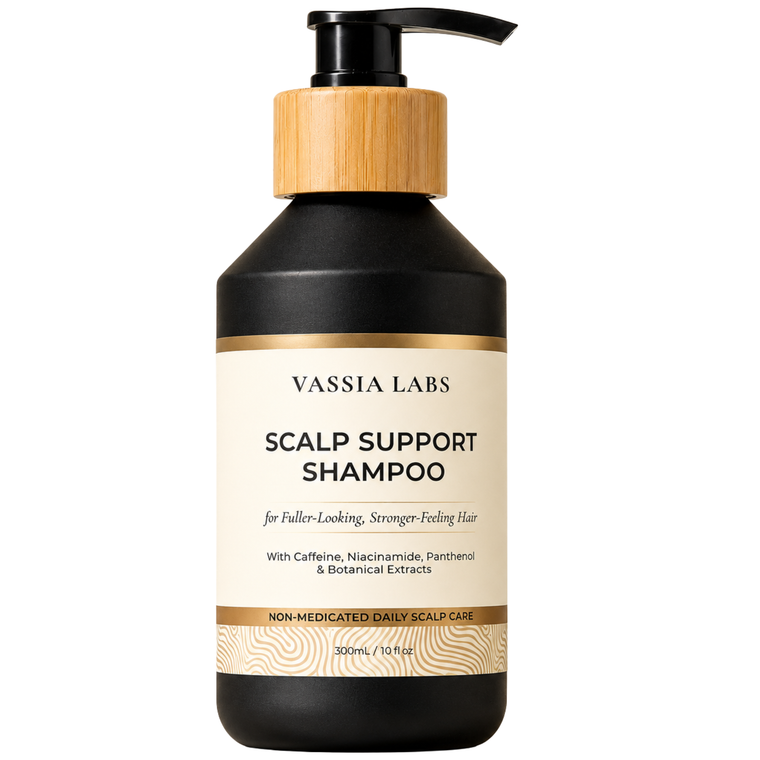
Vassia Labs Scalp Support Shampoo combines botanicals and familiar scalp-care ingredients inside a fragrance-free, sulfate-free and silicone-free cleansing formula designed for fine, thinning-looking hair.
The formula includes rosemary extract, ginseng, saw palmetto, aloe, centella, chamomile and other supporting ingredients, alongside caffeine, niacinamide, panthenol and hydrolyzed wheat protein.
The purpose is straightforward: cleanse everyday buildup, leave roots feeling lighter and support stronger-feeling, fuller-looking hair. It is not positioned as a drug or a treatment for the underlying causes of hair loss.
For the evidence behind one of the most talked-about botanicals, read Rosemary in Shampoo: What It Can and Cannot Do.
Frequently asked questions
Are herbal shampoos better than regular shampoos?
Not as a category. A well-formulated botanical shampoo can be excellent, and a poorly formulated one can be irritating or ineffective. Judge the finished product.
Can botanical shampoo regrow hair?
Do not assume so. Some botanical ingredients have promising research in specific formats, but a cosmetic rinse-off shampoo should not be treated as proven therapy for hair loss.
Is rosemary shampoo good for fine hair?
It can be if the overall shampoo is lightweight and cleanses well. Rosemary itself does not determine whether the finished formula will suit fine hair.