K-beauty has spent years teaching consumers to think about skin in layers: cleanse properly, support the barrier, avoid unnecessary irritation and choose ingredients for a reason.
In 2026, that mindset is moving north.
Korean-inspired hair care is increasingly focused on the scalp, with scalp cleansers, lightweight serums, rosemary formulas, amino acids, proteins and skin-care-style ingredients appearing across the category.
You do not need a twelve-step scalp routine or a shelf that looks like a small laboratory. But fine hair can borrow several useful ideas from the movement.
1. Shampoo the scalp, not the ends
The most useful scalp-care lesson is also one of the simplest: shampoo should primarily cleanse the scalp.
The American Academy of Dermatology recommends applying shampoo to the scalp rather than aggressively scrubbing the full length of the hair. The lather that runs through the lengths during rinsing is usually enough for ordinary cleansing.
For fine hair, this matters because the roots collect oil, sweat, dry shampoo and styling residue while the ends are often more fragile.
2. Treat scalp comfort as part of hair care
A comfortable scalp is not the same thing as guaranteed hair growth, but scalp condition still matters.
Modern K-beauty-inspired formulas often include ingredients familiar from skin care, such as niacinamide, panthenol, centella and hyaluronic acid. These ingredients do not magically convert a shampoo into a hair-loss treatment. They can, however, make sense in formulas designed around scalp comfort and conditioning.
That distinction matters. Scalp care should not require pretending every ingredient “activates follicles.”
3. Lightweight is a feature when hair is fine
Fine hair has a smaller strand diameter, so it is easier for oil, conditioner, silicones, butters and styling products to pull the roots together and reduce visible volume.
This is why many Korean hair products aimed at oily scalps or fine hair emphasize clean rinsing and lighter textures.
The goal is not to make hair squeaky. It is to remove enough residue that individual strands can separate rather than clump into flat sections.
4. Botanicals should have a job, not a mythology
Rosemary, ginseng and other botanicals are prominent in Korean and broader Asian hair-care formulas. Some have interesting laboratory or clinical research behind specific preparations.
But “traditional” and “natural” do not mean clinically proven in every format.
For example, rosemary has human research in hair loss, but that does not prove every rosemary shampoo produces the same outcome. Concentration, vehicle and contact time matter.
A better way to read a botanical formula is to ask: Does this ingredient contribute to scalp feel, cleansing, conditioning or the overall product experience without requiring exaggerated promises?
5. More scalp stimulation is not always better
Scalp brushes, cooling formulas, exfoliants and massage are common in modern scalp routines. Used appropriately, they can make cleansing feel thorough and help distribute product.
Used aggressively, they can also irritate skin and tangle fragile hair.
If your scalp is already itchy, burning or inflamed, attacking it with a silicone brush and three acids is not “detox.” It is enthusiasm exceeding judgment.
Use fingertips gently when shampooing. If you use a scalp tool, avoid scratching and stop if it worsens discomfort.
6. Consistency beats routine complexity
The scalp accumulates oil, dead skin, sweat and styling residue continuously. Regular cleansing that suits your own oil production is more useful than periodically performing an elaborate “reset.”
The AAD advises washing based on how oily or dirty the hair becomes. People with straight hair and oily scalps may need frequent washing; other hair types may need less.
There is no medal for stretching wash day if your roots are uncomfortable and coated.
7. Keep medical hair loss separate from cosmetic scalp care
This is the line many trend-led routines blur.
Scalp shampoo can improve cleanliness, comfort and the appearance of fine roots. It cannot tell you why density is changing.
If you notice sudden heavy shedding, bald patches, scarring, persistent scalp inflammation, a widening part or a major drop in ponytail density, a dermatologist can help identify the cause.
A simple K-beauty-inspired routine for fine hair
- Pre-wash: Brush gently if needed to remove loose tangles.
- Cleanse: Apply shampoo directly to the scalp and massage with fingertips.
- Rinse thoroughly: Residue around the crown, nape and behind the ears can make roots feel heavy.
- Condition strategically: Apply lightweight conditioner mainly from mid-lengths to ends.
- Use leave-ons selectively: Add a scalp serum only if it has a clear purpose and does not make your roots greasy.
- Watch the result: Your scalp should feel comfortable and your roots should not feel coated immediately after washing.
Where Vassia Labs fits
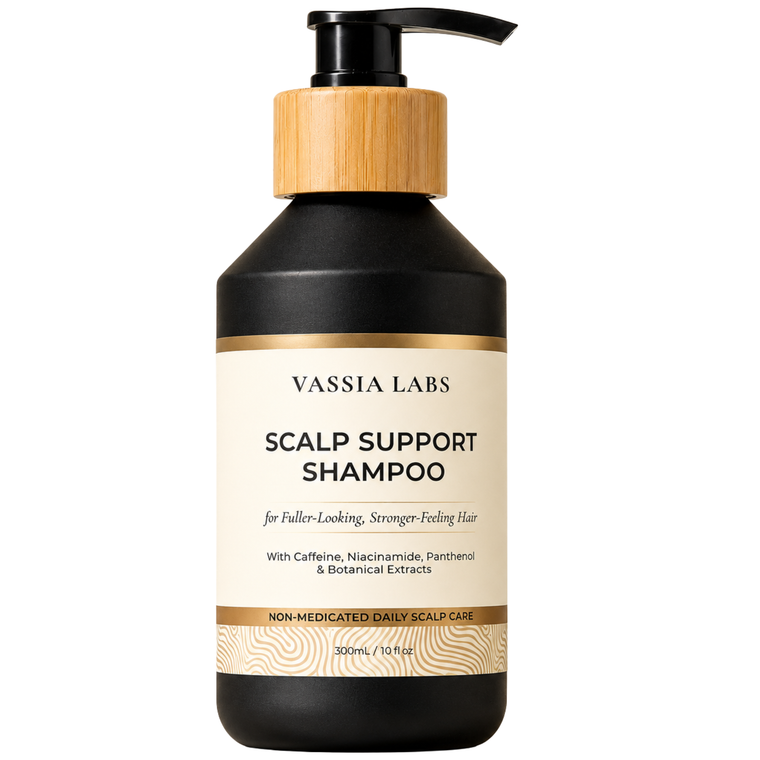
Vassia Labs Scalp Support Shampoo uses the same scalp-first logic without asking you to build a complicated routine. The fragrance-free, sulfate-free and silicone-free formula is designed to remove everyday oil and buildup while leaving fine roots feeling lighter.
It includes niacinamide, caffeine, rosemary extract, ginseng, aloe, centella and panthenol as part of a balanced cosmetic formula for scalp comfort and stronger-feeling strands.
For a deeper look at the ecosystem living on the scalp, read Scalp Microbiome Care: What It Means for Shampoo and Scalp Health.
Frequently asked questions
Is Korean hair care better for fine hair?
Not automatically. The useful part is the formulation philosophy: scalp-focused cleansing, lightweight textures and deliberate ingredient choices. A product still has to suit your own hair and scalp.
Do I need a scalp serum after every wash?
No. A serum is optional. If your main problem is oil, buildup and flat roots, improving cleansing technique may provide more immediate value.
Should fine hair be washed every day?
Some people with fine, straight hair and oily scalps may benefit from frequent washing. Frequency should be based on oil, buildup, comfort and hair type rather than a fixed rule.