Direct answer: scalp microbiome care is best treated as a scalp-comfort concept, not a promise that shampoo can engineer a perfect microbial balance. The scalp naturally supports bacteria and fungi, and cleansing can alter their environment, but a lasting “rebalancing” claim requires appropriate testing of the finished product.
For everyday hair care, the practical goal is simpler: remove excess oil, sweat and residue while avoiding a routine that repeatedly leaves the scalp irritated, tight or heavily coated.
What is the scalp microbiome?
The scalp, like other skin, hosts a community of microorganisms. Research has found associations between microbial patterns and conditions such as dandruff, but association does not prove that ordinary cosmetic shampoo can permanently reset those communities or treat a disease.
The word “microbiome” has therefore become much more commercially confident than the underlying consumer evidence often justifies. Tiny organisms, as usual, have been recruited into marketing without being consulted.
What can change the scalp environment?
Factors include:
- oil production
- wash frequency
- the surfactant system
- product residue
- fragrance or personal allergens
- medicated products
- sweat and occlusion
- underlying inflammatory scalp conditions
That does not mean every change is harmful. Shampoo is supposed to change the scalp environment temporarily by removing oil and residue.
What can “microbiome-friendly” legitimately mean?
At most, without specific finished-product evidence, it may indicate a formula intended to be compatible with regular use or scalp comfort. It should not automatically be interpreted as proof that the product increases microbial diversity, restores an ideal bacterial ratio or treats dandruff.
If a brand makes a specific microbiome claim, look for finished-product testing and a clear explanation of what was actually measured.
Surfactants matter more than buzzwords
Surfactants are the cleansing ingredients in shampoo. They interact with oil, residue and the skin surface, and the complete surfactant system influences both cleansing and tolerance.
It is too simplistic to label one surfactant “good” and another “bad” from the ingredient list alone. Concentration, co-surfactants, pH and formulation structure all matter.
Read Shampoo Surfactants Explained for the chemistry.
How the scalp barrier fits in
The scalp microbiome sits on skin, so barrier comfort and microbial marketing should not be treated as separate universes.
Research on cleansing shows that surfactants can interact with the stratum corneum and that formulation design can reduce unnecessary disruption. That is more concrete than assuming a “prebiotic” word on the bottle guarantees a healthier scalp ecosystem.
See How to Support the Scalp Barrier Without Weighing Down Fine Hair.
Does fragrance matter?
Fragrance is not automatically harmful, but it can be a contact-allergy trigger for susceptible people. If fragrance avoidance is your goal, look for fragrance-free rather than assuming “unscented” means the same thing.
A fragrance-free product can still irritate an individual. It simply removes one potential variable.
Do you need to wash less to protect the microbiome?
No universal rule supports that.
Wash according to scalp oil, sweat, product use and hair type. Allowing heavy oil and styling residue to accumulate is not automatically healthier for the scalp simply because fewer washes occurred.
The American Academy of Dermatology recommends adjusting washing to how quickly the scalp becomes dirty or oily.
A practical scalp-friendly routine
- Wet the scalp thoroughly with comfortably warm water.
- Use enough shampoo to clean the scalp without piling on excess product.
- Massage with fingertips, not nails.
- Rinse the crown, nape, hairline and behind the ears carefully.
- Apply ordinary conditioner mainly to the lengths if your roots flatten easily.
- Introduce new scalp products one at a time if you are prone to sensitivity.
- Stop a product that repeatedly causes burning, rash or swelling.
Where Vassia Labs fits
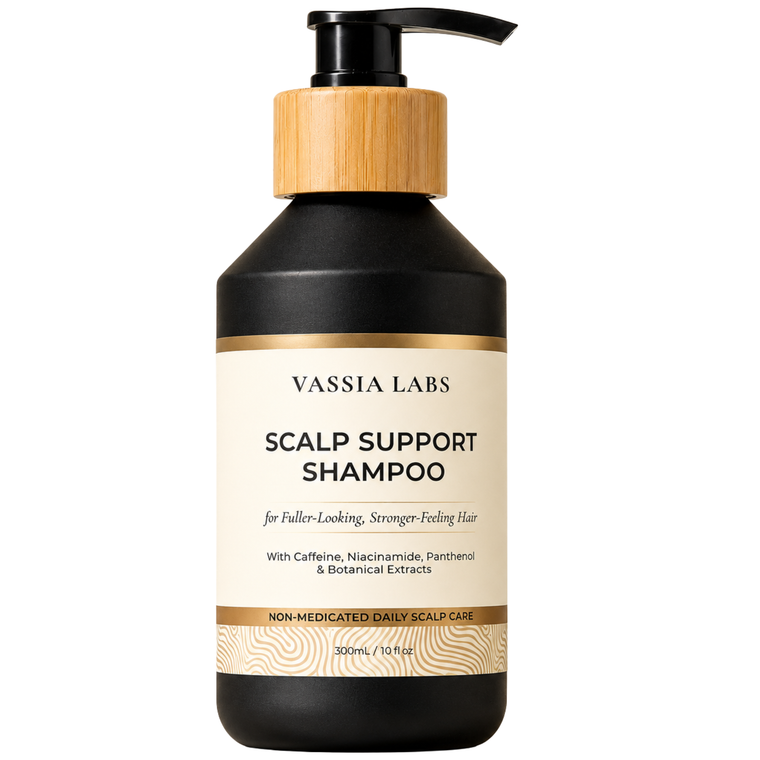
Vassia Labs Volumizing Shampoo is a fragrance-free, sulfate-free and silicone-free cosmetic cleanser for fine, flat and thinning-looking hair. It includes scalp-focused ingredients such as niacinamide, panthenol, aloe and centella alongside caffeine and rosemary.
We do not claim that the finished shampoo has been proven to permanently rebalance the scalp microbiome. Its defensible role is regular cleansing, scalp-focused cosmetic care and a lightweight finish.
When “microbiome imbalance” is the wrong question
Persistent greasy scale, significant itching, redness, pain, sores, hair loss or symptoms extending beyond the scalp may reflect a condition that requires specific diagnosis or treatment.
Do not keep buying “balance” products indefinitely when the problem is behaving like dermatitis, psoriasis, infection or another medical condition.
Frequently asked questions
Can shampoo change the scalp microbiome?
Shampoo changes the scalp environment during cleansing, but lasting microbiome claims require appropriate finished-product evidence.
Is microbiome-friendly the same as gentle?
No. It is a marketing description unless supported by specific testing. Judge the complete formula and how your scalp responds.
Should I avoid washing to protect scalp bacteria?
No. Wash according to oil, sweat and buildup. Less frequent washing is not automatically healthier.
Are sulfate-free shampoos better for the microbiome?
That has not been established as a universal rule. The complete surfactant system and formulation matter.
Does Vassia Labs make a microbiome claim?
No finished-product microbiome claim is made. The formula is positioned for lightweight cleansing and scalp-focused cosmetic care.
Related guides
- How to Support the Scalp Barrier
- Shampoo Surfactants Explained
- Complete Sensitive Scalp Shampoo Guide
- Shampoo pH for Fine Hair