Menopause can coincide with thinner-looking hair, but a change in density should not automatically be blamed on hormones. Female-pattern hair loss commonly becomes more noticeable in midlife, and the American Academy of Dermatology (AAD) notes that hormones may play a role after menopause. Temporary shedding, breakage, medication changes, illness and hair-care damage can also affect fullness.
The useful first step is to work out whether you are seeing progressive density loss, temporary shedding, shaft breakage or cosmetic flatness. Those problems can look similar in a mirror but need very different responses.
What hair changes are common around menopause?
Some women notice a wider part, a smaller ponytail or less coverage through the crown. Those are classic signs worth taking seriously because female-pattern hair loss is progressive and is most effectively assessed early.
Other people mainly notice more hair during washing after a major stressor, illness, rapid weight change or medication change. That can fit excessive shedding rather than patterned loss. Breakage can also reduce fullness through the lengths without changing the number of follicles.
How do you tell shedding, breakage and patterned thinning apart?
- Shedding: more full-length hairs releasing across the scalp, often after a trigger and sometimes delayed by a few months.
- Breakage: shorter snapped pieces, frayed ends and damage concentrated where heat, bleach, friction or tension are greatest.
- Patterned thinning: a part that continues to widen, reduced density over the top of the scalp or a ponytail that becomes consistently smaller.
- Flatness: roots that look sparse mainly when oily, over-conditioned or coated in styling residue, then look fuller after washing and drying.
For the full framework, read the Complete Guide to Thinning-Looking & Fragile Hair.
What can you do at home?
- Track changes consistently. Photograph the part and crown every month in similar lighting and with dry hair.
- Reduce avoidable breakage. Limit unnecessary heat, bleach, tight styles and rough detangling.
- Keep conditioning lightweight. Fine hair often maintains more lift when richer conditioner is concentrated through the lengths rather than the roots.
- Wash according to scalp needs. Let oil, sweat and buildup determine frequency rather than avoiding shampoo because loose hairs become visible in the shower.
- Get progressive change assessed. A widening part or steadily declining density is not something a cosmetic shampoo can diagnose.
Can shampoo help menopausal thinning?
Shampoo can improve the appearance and feel of existing hair. A lightweight cleanser can remove oil and buildup so fine strands separate more evenly and roots look less collapsed. Gentle care can also reduce avoidable breakage.
What shampoo cannot do is regrow hair lost to female-pattern hair loss or stop a progressive hair-loss disorder. The AAD notes that hair-loss shampoos may help hair look fuller or reduce breakage, but they do not regrow hair or prevent worsening of female-pattern hair loss.
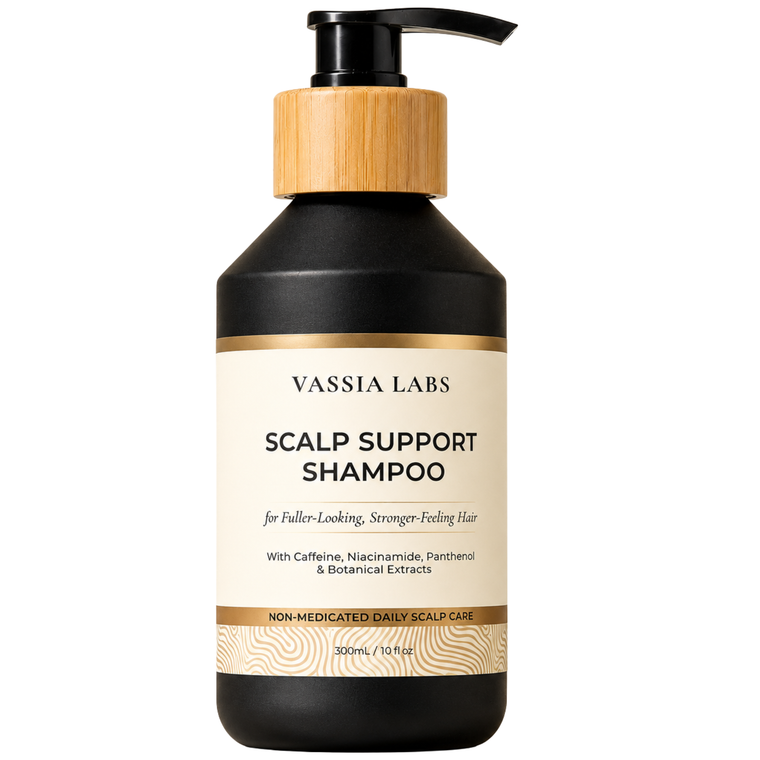
Vassia Labs Scalp Support Shampoo is a non-medicated, fragrance-free, sulfate-free and silicone-free cosmetic shampoo for fine, flat and thinning-looking hair. Its role is lightweight cleansing and fuller-looking wash days, not treatment of menopausal hair loss.
When should you see a dermatologist?
Arrange assessment for a progressively widening part, a clearly smaller ponytail, patchy loss, recession, persistent heavy shedding, scalp pain or burning, thick scale, sores or scarring. A dermatologist can distinguish patterned hair loss from temporary shedding and other causes and discuss evidence-based treatment when appropriate.
Frequently asked questions
Does menopause always cause hair loss?
No. Hair changes in midlife have multiple possible causes. Menopause may coincide with female-pattern hair loss, but temporary shedding, breakage and other medical factors can also affect fullness.
Can menopausal hair become permanently thinner?
Progressive female-pattern hair loss can reduce density over time. That is different from temporary excessive shedding, which can recover after a trigger resolves.
Can volumizing shampoo make a difference?
It can make existing fine hair look fuller by reducing residue and improving root lift. That cosmetic effect should not be confused with regrowing lost hair.