Postpartum hair shedding usually becomes noticeable a few months after giving birth and is generally temporary. The American Academy of Dermatology (AAD) explains that falling estrogen levels after delivery can trigger excessive shedding, also called telogen effluvium. Shedding often peaks around four months postpartum, but real people do not follow an exact calendar.
Most women gradually regain their normal hair fullness, and the AAD notes that this commonly happens by the child’s first birthday. A different or persistent pattern deserves medical evaluation rather than another increasingly ambitious shampoo claim.
Why postpartum shedding happens
During pregnancy, hormonal changes can keep more hairs in the growing phase. After delivery, estrogen levels fall and more hairs can move into the shedding phase. Because the hair cycle has a delay, the visible shedding usually does not begin the day after birth.
This is why someone can feel as though their hair looked unusually full during pregnancy and then suddenly see much more hair in the shower several months later.
A realistic postpartum timeline
The first weeks after birth
You may not notice much change yet. Hair cycling takes time, and recovery from pregnancy and delivery varies widely.
A few months postpartum
Shedding may become more obvious. The AAD describes noticeable postpartum shedding a few months after birth.
Around four months
For many women, this is around the time shedding is most noticeable. Treat this as a common pattern, not a deadline your scalp is required to obey.
Later in the first year
The shedding usually eases and fullness gradually improves. The AAD says most women see their hair return to its normal fullness by their child’s first birthday.
What can make postpartum hair look even thinner?
Temporary shedding is only part of the visual picture. Fine strands can also look flatter when roots are oily, when conditioner reaches the scalp, or when heavy styling residue makes strands clump together. Breakage from heat, bleach, tight styles or rough detangling can reduce fullness through the lengths as well.
That distinction matters because washing away buildup can improve root lift, but it does not mean a shampoo reversed postpartum telogen effluvium.
What can you do during postpartum shedding?
- Keep cleansing simple. Wash often enough to keep your scalp comfortable rather than avoiding shampoo out of fear of seeing shed hairs.
- Handle fragile lengths gently. Reduce unnecessary heat, tight hairstyles and aggressive detangling.
- Use lightweight conditioning. Focus conditioner on the lengths if your roots flatten easily.
- Judge trends monthly, not daily. Daily shower-drain counting usually creates more anxiety than useful information.
- Ask for medical advice when something does not fit. Persistent, patchy, painful or progressive loss deserves assessment.
Can volumizing shampoo help postpartum hair?
It can help cosmetically. The AAD specifically notes that volumizing shampoo can make hair look fuller during postpartum shedding. The effect comes from how existing strands look and behave, not from creating new follicles.
If your hair is fine and easily weighed down, the Complete Guide to Thinning-Looking & Fragile Hair explains how to separate shedding from breakage and flatness.
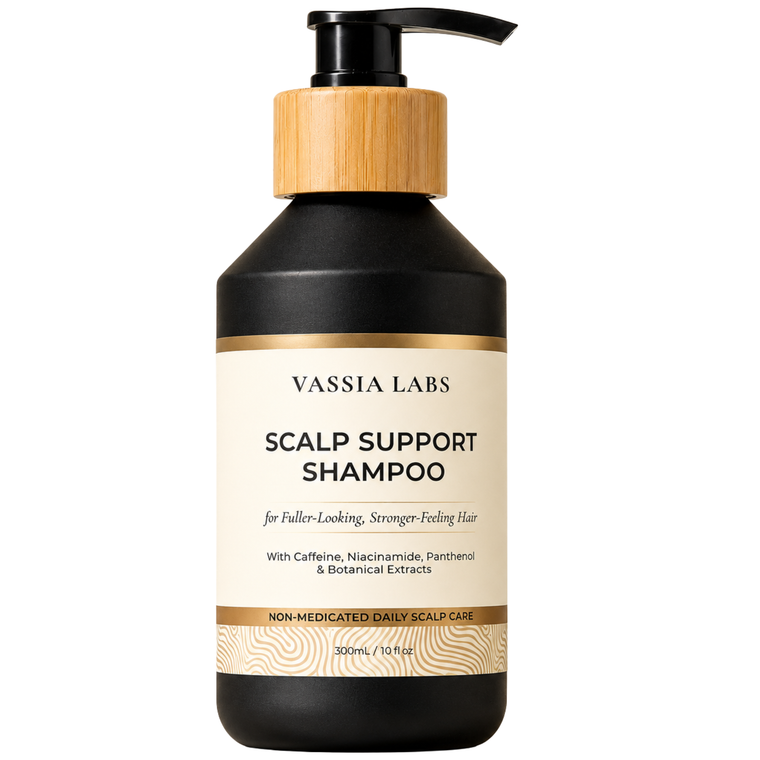
Vassia Labs Scalp Support Shampoo is a fragrance-free, sulfate-free and silicone-free cosmetic cleanser for fine, flat and thinning-looking hair. It is designed to remove everyday oil and buildup and support fuller-looking wash days. It does not treat postpartum hair loss.
When postpartum shedding needs medical attention
Talk with a qualified healthcare professional or dermatologist if hair loss is patchy, painful, associated with scalp inflammation or scarring, continues to worsen rather than gradually settle, or is accompanied by other unexplained symptoms. Postpartum life can overlap with thyroid, nutritional and other health issues, so a persistent change should not simply be labelled “normal postpartum hair.”
Frequently asked questions
When does postpartum hair shedding usually start?
It commonly becomes noticeable a few months after birth rather than immediately after delivery.
When does postpartum shedding peak?
The AAD says postpartum shedding often peaks around four months after giving birth, although individual timing varies.
Will my hair go back to normal?
Postpartum telogen effluvium is usually temporary. The AAD says most women see normal fullness return by the child’s first birthday.
Should I stop washing my hair because it sheds in the shower?
No. Washing makes loose hairs more visible but does not create postpartum telogen effluvium. Choose a wash frequency that keeps your scalp comfortable.