Red-light caps, combs and helmets have moved from niche hair-loss clinics into ordinary bathroom cabinets. In 2026, major beauty and technology publications are treating red-light hair devices as a mainstream category rather than a futuristic curiosity.
The category also has something many hair-growth trends do not: real clinical evidence.
That does not mean every glowing helmet will regrow hair, or that red light works for every cause of shedding. The important question is not “Does red light work?” It is what type of hair loss was studied, what device was used, and what outcome was measured?
The direct answer
Low-level light therapy, also called LLLT or photobiomodulation, has evidence supporting modest improvements in hair density for androgenetic alopecia, the hereditary pattern-hair-loss condition that can affect both men and women.
A 2025 systematic review and meta-analysis covering 38 studies and more than 3,000 patients found a significant increase in hair density for people with androgenetic alopecia compared with placebo. A 2026 systematic review of lasers and energy-based devices also reported improvements in density and shaft thickness.
Evidence is much thinner for other causes of hair loss such as telogen effluvium, alopecia areata, scarring alopecia and shedding related to illness or nutritional problems.
So the useful version of the claim is:
Red-light therapy may help some people with pattern hair loss when used consistently over time. It is not a universal treatment for every type of thinning.
What is low-level light therapy?
LLLT uses low-intensity red or near-infrared light delivered to the scalp. At-home devices may use lasers, LEDs or a combination.
The exact biological pathways are still being studied. Proposed mechanisms involve cellular energy signaling and effects on follicle activity, but consumer explanations often become far more certain than the evidence deserves.
For shoppers, the practical point is simpler: the treatment is non-invasive, repeated regularly, and intended to stimulate existing follicles rather than create new follicles where none remain.
Why is red light suddenly everywhere in 2026?
Three things have converged:
- more at-home devices are available
- beauty consumers are already familiar with red-light face masks
- clinical research on hair applications has accumulated
The American Academy of Dermatology notes that several at-home red-light devices have been FDA-cleared for hair regrowth and that some studies show increased hair thickness and length in hereditary hair loss.
That makes red light more credible than many viral scalp gadgets. It also makes it easier for marketers to stretch the evidence into promises the studies did not make.
What type of thinning has the best evidence?
Androgenetic alopecia
This is where the evidence is strongest.
In women, androgenetic alopecia often appears as gradual thinning over the crown or a widening part. In men, it more commonly affects the hairline, temples and crown in characteristic patterns.
Red-light therapy has been studied most extensively in this group.
Telogen effluvium
Telogen effluvium is a shedding condition that can follow illness, major stress, rapid weight loss, childbirth or other physiological changes.
The 2025 meta-analysis included very few patients with telogen effluvium, so it is not reasonable to assume the same benefit seen in pattern hair loss.
If your main symptom is sudden diffuse shedding, start by understanding the cause rather than immediately buying hardware.
Read Hair Shedding vs Hair Loss: How to Tell the Difference.
Alopecia areata and scarring alopecia
These are medical hair-loss disorders that require proper diagnosis. Evidence for consumer red-light devices is not strong enough to treat a cap or comb as a substitute for medical care.
What results should you realistically expect?
Expectations need to be boring enough to be believable.
Red-light therapy is not an overnight treatment. Studies generally involve repeated use over weeks or months. The AAD stresses that treatment must be used regularly and that not everyone responds.
A realistic goal is potential improvement in hair density or thickness over time, not a dramatic return to childhood hair density.
If a product page promises major regrowth in a few days, you have learned something useful about the product page, if not the device.
How long does red light take to work?
There is no single timeline because devices and protocols differ.
Clinical studies often evaluate outcomes after several months. The 2025 meta-analysis grouped studies using treatment periods from roughly four to 26 weeks.
For home devices, follow the labeled schedule. Using a device more often than directed does not automatically improve the result.
What does “FDA-cleared” actually mean?
In the United States, some hair-growth laser devices are regulated as Class II medical devices and receive 510(k) clearance based on substantial equivalence to a legally marketed predicate device.
That is different from a blanket statement that “red light is FDA approved for hair loss.” The clearance applies to the specific device and its intended use.
Before paying several hundred dollars, check the exact model and regulatory claim rather than relying on a retailer badge that says “FDA” in a reassuring shade of blue.
The FDA database currently lists multiple laser hair-growth devices under product code OAP.
How to evaluate a red-light hair device
1. Verify the exact regulatory status
If the brand claims FDA clearance, search the exact model or 510(k) number in the FDA device database.
2. Check the intended user and condition
Some clearances are written for specific patterns or classifications of androgenetic alopecia. Do not assume the indication is identical across every device.
3. Look for a clear treatment protocol
A credible device should tell you how often and how long it is intended to be used.
4. Be skeptical of enormous percentage claims
Hair-count studies measure outcomes in specific scalp areas under controlled conditions. Translating that into “300% more hair” in a social ad can turn statistics into theatre.
5. Consider whether you know the cause of your thinning
If you do not know why your hair is changing, diagnosis has more value than gadget comparison.
Red light vs minoxidil
These are not interchangeable simply because both can appear in hair-loss discussions.
Minoxidil is an established medical treatment for androgenetic alopecia. LLLT is a device-based option with evidence of benefit in the same condition.
Research comparing combination therapy with minoxidil alone is mixed. One 2025 meta-analysis of four trials found no significant advantage for the combination, while another 2025 meta-analysis of seven randomized trials found greater improvements in density and hair diameter when LLLT was added.
That disagreement is exactly why treatment choices should be discussed with a dermatologist rather than resolved by whichever TikTok has the most dramatic before-and-after lighting.
Can shampoo replace red-light therapy?
No.
A cosmetic shampoo and an LLLT device have completely different jobs.
Shampoo cleans oil, sweat and residue from the scalp and can improve the cosmetic appearance and manageability of existing hair. A cosmetic shampoo does not treat androgenetic alopecia.
Red-light therapy is a device-based intervention studied for follicular hair growth in specific hair-loss conditions.
You can use a suitable shampoo as part of the same overall routine, but the cleanser should not be credited with the medical job of the device.
Where Vassia Labs fits
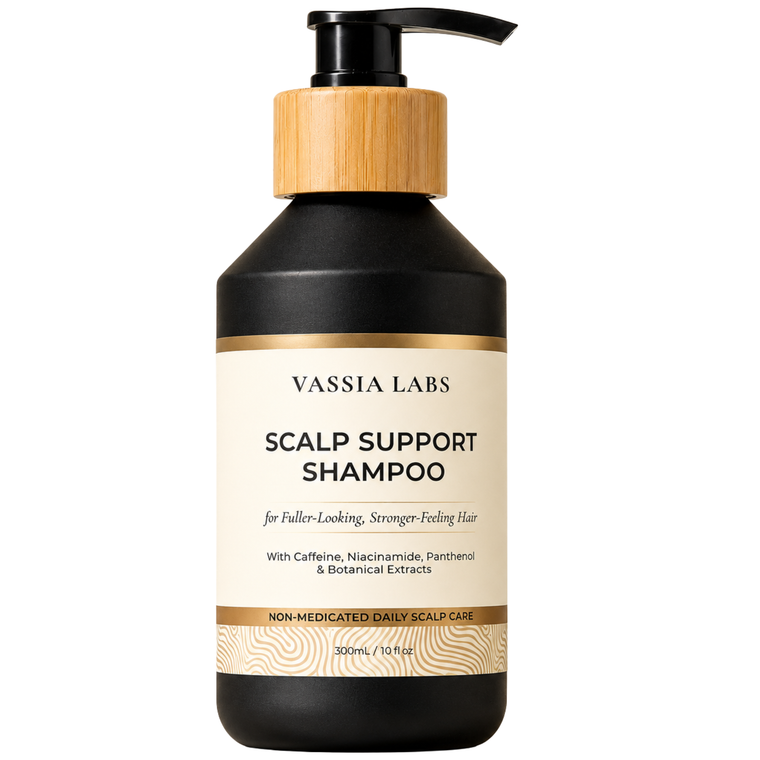
Vassia Labs Scalp Support Shampoo is designed for fine, flat and thinning-looking hair that benefits from lightweight cleansing and scalp care.
It is fragrance-free, sulfate-free and silicone-free, with ingredients including caffeine, rosemary extract, niacinamide, panthenol, ginseng, aloe and centella.
Its role is cosmetic: cleanse the scalp, remove everyday buildup, support stronger-feeling strands and help fine hair look fuller without a heavy coating.
If you use an at-home red-light device, follow the device instructions about whether the scalp should be clean and product-free before treatment. Do not assume a serum, oil or shampoo improves light penetration unless the manufacturer specifically says so.
When to see a dermatologist before buying a device
Get professional evaluation for:
- sudden heavy shedding
- smooth or expanding bald patches
- scalp pain, burning or significant inflammation
- scarring or shiny areas of scalp
- eyebrow or eyelash loss
- a rapidly widening part
- thinning associated with major hormonal or systemic symptoms
See When Hair Shedding Needs a Dermatologist.
Frequently asked questions
Does red light regrow hair?
It can improve hair density in some people with androgenetic alopecia, based on randomized trials and meta-analyses. It does not reliably treat every cause of hair loss.
Are LED caps the same as laser caps?
No. Devices may use LEDs, lasers or both. Evidence and regulatory status should be checked for the specific device rather than assuming every red-light product is equivalent.
Is stronger light better?
Not necessarily. Photobiomodulation depends on dose and protocol. More exposure is not automatically more effective.
Can I use red light with minoxidil?
Combination therapy has been studied, but results across reviews are not perfectly consistent. Ask a dermatologist how to combine treatments safely and logically for your diagnosis.
Will red light help postpartum shedding?
Evidence is much more limited for postpartum telogen effluvium than for androgenetic alopecia. Postpartum shedding usually has a different cause and natural course.
Bottom line
Red-light therapy is not nonsense, and it is not a miracle.
The best current evidence supports it as a potentially useful option for androgenetic alopecia, used consistently over time. The evidence is far less established for many other reasons hair may shed or look thin.
If you are considering a device, first identify the pattern of hair loss, verify the device rather than the marketing, and judge results over months rather than days.
That is less glamorous than buying a glowing helmet because an influencer wore one while making coffee. It is also considerably cheaper than buying the wrong one.
Sources and further reading
- Low-Level Laser and LED Therapy in Alopecia: systematic review and meta-analysis, PubMed
- Lasers and Energy-Based Devices in Androgenetic Alopecia: 2026 systematic review and meta-analysis, PubMed
- Red light therapy and hair loss, American Academy of Dermatology
- FDA device classification: laser, comb, hair