Reverse hair washing sounds like the sort of beauty hack invented because the normal order of shampoo and conditioner had apparently become too peaceful. But for fine hair, there is a practical reason the method keeps resurfacing.
Instead of shampooing first and conditioning second, you apply conditioner to the lengths, rinse, then shampoo the scalp and hair. The goal is simple: keep the softness and detangling benefits of conditioner while reducing the heavy finish that can flatten fine roots.
Vogue brought the technique back into the spotlight in July 2026, specifically highlighting its potential for soft, voluminous hair. The method is not magic, and it will not suit everyone. Used correctly, though, it can be a useful experiment for hair that becomes limp immediately after conditioning.
The direct answer
Reverse washing can help some people with fine, easily weighed-down hair because the final shampoo step removes some of the conditioner residue that would otherwise remain on the strands.
That can leave hair feeling:
- softer through the lengths
- lighter at the roots
- less coated after washing
- easier to lift during blow-drying
- less stringy when dry
It does not permanently thicken hair, increase follicle count or treat hair loss. The effect is cosmetic: less weight can make existing strands separate and move more freely, which can make fine hair look fuller.
What is reverse hair washing?
The usual wash order is:
- Shampoo.
- Rinse.
- Condition.
- Rinse.
Reverse washing changes the sequence:
- Wet the hair thoroughly.
- Apply conditioner mainly to the mid-lengths and ends.
- Let it sit for the time recommended on the label.
- Rinse.
- Shampoo the scalp and roots.
- Rinse thoroughly.
You are not skipping conditioner. You are simply changing when it appears in the routine.
Why can conditioner flatten fine hair?
Conditioner is designed to improve slip, smoothness and manageability. That is useful because wet hair is vulnerable to friction and tangling.
The problem is dosage and placement. Fine strands have a smaller diameter, so a rich coating that feels luxurious on coarse hair can make fine hair collapse into heavier sections.
Common signs that your conditioning step may be too heavy include:
- roots look flat as soon as the hair dries
- lengths separate into stringy sections
- hair feels soft but has little movement
- volume disappears within an hour or two
- you need dry shampoo or texture spray immediately after washing
If that sounds familiar, also read Why Does Conditioner Make My Fine Hair Look Stringy?
Who is most likely to benefit?
Reverse washing is most worth trying if you have:
- fine or very fine strands
- roots that flatten easily
- dry or fragile ends that still need conditioner
- hair that becomes heavy after rich conditioners
- longer hair where the ends need more softness than the roots
- an oily scalp with drier lengths
It can also be useful when you want to keep conditioning in the routine but hate the trade-off between softness and volume.
Who may not like it?
Reverse washing is less likely to suit very dry, coarse, highly textured or heavily chemically damaged hair if shampooing last leaves the ends feeling rough.
You may also prefer the traditional order if:
- your conditioner already rinses very cleanly
- you only use conditioner on the ends
- your hair rarely looks flat after washing
- you rely on conditioner for significant detangling after shampooing
- your shampoo is strong enough to leave the lengths squeaky or rough
This is a technique, not a commandment. Hair care has enough commandments already, most of them issued by people holding ring lights.
How to reverse wash fine hair correctly
1. Saturate the hair completely
Give the water time to move through the hair. Fine hair can look thoroughly wet before the inner sections are fully saturated, especially around the crown and nape.
2. Put conditioner where it is needed
Start around ear level and work downward. If your roots flatten easily, avoid coating the scalp unless the product is specifically designed for scalp use.
Use less than you think you need. You can always add a little more to the ends.
3. Detangle gently
Use your fingers or a wide-tooth comb if needed. Do not yank through wet knots. Conditioner is useful here because it increases slip and can reduce friction during detangling.
4. Rinse before shampooing
Rinse until the hair no longer feels heavily coated. You are not trying to remove every trace of conditioning. You are simply clearing away the excess before the cleansing step.
5. Shampoo the scalp, not the ends
Apply shampoo mainly to the scalp and roots. Massage with fingertips, not nails. Let the lather that moves through the lengths during rinsing do most of the work there.
This is especially important if the ends are dry or fragile.
6. Rinse more thoroughly than you think is necessary
Fine hair shows residue quickly. Pay attention to the crown, nape, behind the ears and underneath longer sections.
7. Judge the result only after the hair is fully dry
Wet hair clumps together and naturally looks flatter. Compare the final dry result with your normal wash routine.
Reverse washing vs regular washing
| Method | Potential advantage | Potential downside |
|---|---|---|
| Shampoo then conditioner | Maximum softness and detangling after cleansing | Rich conditioner can leave fine hair heavy |
| Conditioner then shampoo | Can reduce coated feel and preserve more root movement | Ends may feel less conditioned if shampoo is strong |
| Shampoo + conditioner only on ends | Simple compromise for many fine-hair routines | May still feel heavy if too much conditioner is used |
Does reverse washing actually create more volume?
It can create the appearance of more volume when the normal routine leaves too much conditioning residue behind.
The mechanism is not mysterious. Fine hair looks fuller when strands are able to separate, move and lift away from one another. Heavy coatings can reduce that movement.
Reverse washing can therefore improve volume indirectly by reducing weight. It does not change the biological diameter of the strand or create new hair.
Should you reverse wash every time?
Only if your hair consistently prefers it.
A sensible test is to compare three washes:
- your normal routine
- reverse washing
- normal washing with half your usual conditioner
Keep styling products and drying method the same. That gives you a cleaner comparison than changing five variables at once and then blaming whichever bottle looks most suspicious.
What if your roots are oily but your ends are dry?
This is one of the better use cases for reverse washing.
Condition the dry lengths first, then cleanse the scalp carefully. The final shampoo step helps prevent the roots from inheriting the richness intended for the ends.
For more detail, see How to Choose a Shampoo for an Oily Scalp and Dry Ends.
Where Vassia Labs fits
If your main problem is that fine roots become coated or flat, the shampoo itself still matters.
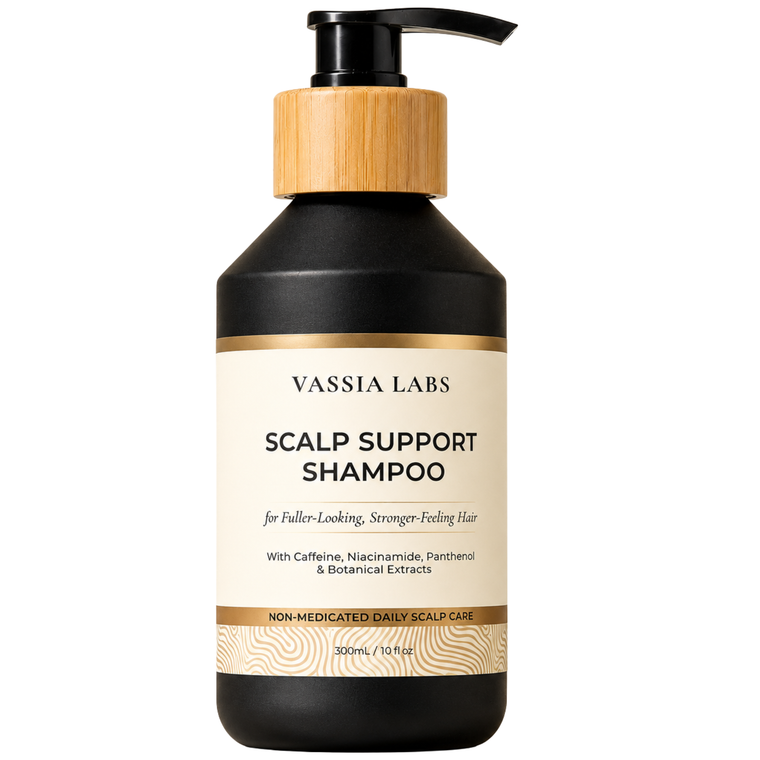
Vassia Labs Scalp Support Shampoo is designed for fine, flat and thinning-looking hair. It is fragrance-free, sulfate-free and silicone-free, with a lightweight cleansing approach intended to remove everyday oil and buildup without leaving a heavy root coating.
If you reverse wash, apply your conditioner to the lengths first, rinse, then use Vassia Labs primarily at the scalp. If your hair feels soft and lifted afterward, the method is doing its job. If the ends feel rough, return to your normal order or use a tiny amount of conditioner only on the ends after shampooing.
Common reverse-washing mistakes
- Using too much conditioner. Changing the order does not make half a palmful of mask suddenly weightless.
- Putting conditioner on the roots. If root volume is the goal, keep richer products away from the scalp.
- Shampooing the lengths aggressively. Focus the cleanser where oil and buildup accumulate most: the scalp.
- Using a very harsh shampoo. Reverse washing should not leave the ends squeaky or tangled.
- Changing styling products at the same time. You will not know which variable produced the result.
Frequently asked questions
Can reverse washing make thin hair thicker?
No. It can make fine or flat hair look fuller by reducing excess conditioning weight, but it does not increase the number of hairs or permanently enlarge strands.
Can I reverse wash if I have a sensitive scalp?
Yes, if the products themselves suit your scalp. Keep conditioner off the scalp unless it is intended for scalp use, and stop using any product that causes burning, persistent itching or rash.
Do I still need conditioner?
If your lengths tangle, feel rough or are chemically processed, conditioner can still be useful. Reverse washing is about placement and sequence, not declaring war on conditioner.
Can I reverse wash with a hair mask?
You can, but a rich mask may still be too heavy for fine hair. Start with a small amount on the lower lengths and ends.
Is reverse washing better than double shampooing?
They solve different problems. Reverse washing is mainly about conditioning without excess weight. Double shampooing is mainly about removing more oil or buildup when one cleanse is not enough.
Bottom line
Reverse hair washing is one of the rare beauty trends that is simple, inexpensive and easy to test.
If your fine hair needs conditioner but repeatedly dries flat, try putting conditioner first and shampoo second for a few wash days. The best result is not dramatic transformation. It is something more useful: soft lengths, cleaner roots and enough movement that your hair does not surrender its volume before you leave the bathroom.