Fine-hair styling has a vocabulary problem.
Mousse promises volume. Root-lift spray promises volume. Texturizing spray promises volume. Dry shampoo somehow also promises volume. Even shampoo is sold for volume. If every bottle does the same thing, the bathroom shelf begins to look like a small, expensive committee meeting.
They do not do the same thing.
In August 2026, Vogue's latest guide to volumizing products for fine hair highlighted a mix of mousses, sprays and mists because different formats solve different stages of the problem. The most useful approach is to match the product to the kind of volume you actually want.
The direct answer
- Volumizing shampoo: creates a clean, lightweight base and removes oil or residue that collapses fine roots.
- Root-lift spray: targets lift at the scalp and crown, usually before blow-drying.
- Mousse: adds broader body, shape and support through larger sections of hair.
- Texturizing spray: adds dry grip and separation after styling.
- Dry shampoo: absorbs some oil and can create texture, but it is not a substitute for washing.
If you only remember one thing, remember this: root lift, body, texture and cleanliness are four different problems.
Why fine hair loses volume so easily
Fine hair has a smaller strand diameter than coarse hair. It can still be dense, but each individual fiber is relatively light and easy to weigh down.
Volume can disappear because of:
- scalp oil
- conditioner or styling residue
- humidity
- heavy oils and creams
- insufficient root lift during drying
- styles with no structure or grip
- too many “volumizing” products layered together
This is why buying one product labeled “volume” does not necessarily fix the problem.
1. Volumizing shampoo: the foundation
Shampoo does not hold a hairstyle in place. Its role is earlier and less glamorous: remove enough oil and buildup that the roots are free to move.
For fine hair, that matters more than it sounds.
Oil causes strands to group together. Heavy residue reduces separation. When small-diameter hairs collapse into coated sections, the scalp can become more visible and the overall style looks flatter.
A good wash gives styling products a clean surface to work with.
If your hair is flat immediately after washing, read Why Are My Roots So Flat After Washing?.
2. Root-lift spray: best for the scalp area
A root-lift spray or mist is designed to be concentrated near the roots rather than distributed heavily through the full length.
It is most useful if your complaint is:
- “My crown lies flat.”
- “My part looks too wide after styling.”
- “The ends have body but the roots collapse.”
- “My blowout looks good everywhere except the first two inches.”
Apply it to damp roots in sections, then use the dryer to direct the hair away from the scalp.
The product alone is rarely the entire trick. Root lift works best when the drying direction supports it.
Best for
Targeted lift at the crown, part and front hairline.
Main risk for fine hair
Overapplication can leave the roots sticky, stiff or dirty-feeling.
3. Volumizing mousse: best for overall body
Mousse is useful when you want shape through more of the hair, not only at the scalp.
Depending on the formula, it can add:
- body
- grip
- style memory
- support for waves or blowouts
- fullness through the mid-lengths
Modern mousses can be much lighter than the crunchy foam formulas people remember from previous decades.
For fine hair, start with a modest amount and distribute it evenly. A giant cloud of foam is not a stronger commitment to volume. It is mostly a stronger commitment to washing your hands afterward.
Best for
All-over body, blowouts, waves and styles that need support.
Main risk for fine hair
Too much mousse can make the hair feel stiff, tacky or grouped together.
4. Texturizing spray: best for dry grip and separation
Texturizing spray usually comes in after the hair is dry.
Instead of creating smooth lift, it creates a little friction and grip. That can make curls, waves, layers or loose styles look more dimensional.
It is useful when freshly washed hair is so soft that it refuses to hold shape.
Spray lightly through the mid-lengths or underneath sections, then use your fingers to separate and build texture.
Best for
Second-stage styling, piecey separation, wave definition and lived-in volume.
Main risk for fine hair
Repeated use can create buildup, dryness or a gritty feel.
5. Dry shampoo: oil control first, volume second
Dry shampoo can make roots look fuller because it absorbs some oil and increases texture.
But it does not remove oil, sweat or product from the scalp. It stays there until you wash it out.
That makes it useful for extending a style, but poor as a permanent substitute for washing.
See Does Dry Shampoo Cause Scalp Buildup?.
Which volumizing product should you choose?
| Your problem | Best starting product | Why |
|---|---|---|
| Roots oily and flat | Lightweight shampoo | Removes the weight before styling |
| Crown has no lift | Root-lift spray | Targets the first few inches |
| Whole style lacks body | Mousse | Adds support through larger sections |
| Hair is too silky to hold shape | Texturizing spray | Adds grip and separation |
| Second-day roots are oily | Dry shampoo | Temporarily absorbs oil |
| Ends are flat but roots are fine | Mousse or light styling foam | Adds body without concentrating everything at scalp |
Do you need all of them?
Usually not.
For most fine hair, a high-performing routine is more likely to use two or three well-chosen products than six products all trying to create volume in slightly different fonts.
A simple routine might be:
- Lightweight shampoo.
- Small amount of conditioner on the ends.
- Root-lift spray at the crown.
- Blow-dry.
- Optional tiny amount of texture spray through dry lengths.
Or:
- Lightweight shampoo.
- Conditioner on lower lengths.
- Mousse through damp hair.
- Blow-dry or diffuse.
- No texture spray unless the finished style needs more grip.
How to layer volume products without making fine hair flat
Use one product for each job
If a mousse already gives your roots and lengths enough support, you may not need a root spray too.
Apply the lightest useful amount
Fine hair punishes optimism. Start small.
Keep rich products away from the roots
Conditioner, oil and smoothing cream belong mainly where the hair is dry or damaged.
Let styling technique do part of the work
Lift the roots while drying. Use clips or rollers if they help. Change the part temporarily while the roots cool. Product should support shape, not perform all the engineering alone.
Wash out accumulated styling residue
If your volume products stop working, the answer may be less product rather than more.
What is best for very fine or thinning-looking hair?
When scalp visibility is part of the concern, prioritize products that create lift without making hairs clump together.
A strong combination is usually:
- clean roots
- minimal conditioner near the scalp
- targeted root lift
- controlled blow-drying
- light texture only where needed
Very greasy, wet-look or heavily oiled roots can make low-density areas more visible because the strands group together.
Where Vassia Labs fits
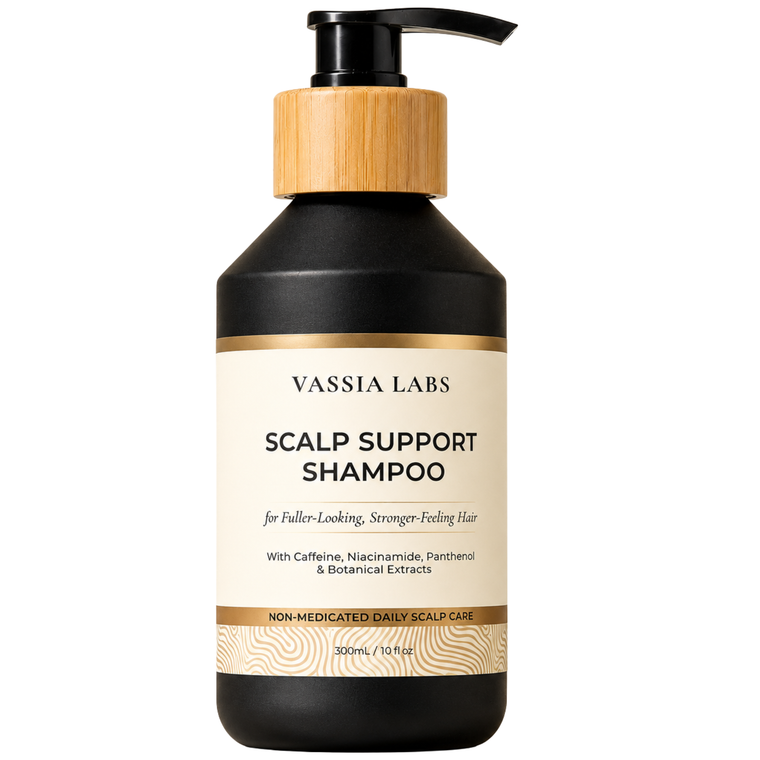
Vassia Labs Scalp Support Shampoo is designed to handle the first step: a clean, lightweight base for fine, flat and thinning-looking hair.
It is fragrance-free, sulfate-free and silicone-free and contains ingredients including caffeine, rosemary extract, niacinamide, panthenol, ginseng, aloe, centella and hydrolyzed wheat protein.
Its role is not to behave like hairspray in the shower. It cleanses everyday oil and buildup and helps leave roots light enough that styling products can do their actual jobs afterward.
That distinction matters. Shampoo should not need to form a stiff styling film to make a “volume” claim useful.
A three-product volume routine for fine hair
If you want the simplest starting point:
- Wash: cleanse the scalp thoroughly and rinse well.
- Lift: apply root spray only where the hair collapses most.
- Finish: add a small amount of texture spray only if the dry style needs more grip.
If your lengths are especially flat, substitute mousse for the root spray.
Then evaluate the result before buying anything else. Civilization will continue even if your shelf contains an empty space.
Frequently asked questions
Is mousse better than root-lift spray for fine hair?
Neither is universally better. Mousse is better for broader body; root-lift spray is better for targeted lift at the scalp and crown.
Can I use mousse and root spray together?
Yes, but start conservatively. Use root spray only where needed and a small amount of mousse through the rest of the hair.
Does texturizing spray damage fine hair?
Not inherently, but frequent use can increase dryness, tangling or buildup depending on the formula. Brush and wash gently rather than repeatedly layering more product.
Can shampoo alone give lasting volume?
Shampoo can create a lighter base by removing oil and residue, but lasting styled volume usually depends on drying technique and styling support.
What is the best product for flat roots after one day?
If oil is the main cause, a small amount of dry shampoo may help temporarily. If the roots are clean but simply lack lift, a root-lift product used during the next styling session may be more useful.
Bottom line
Choose volume products by function, not by how enthusiastically the word “volume” appears on the bottle.
Cleanser for weightless roots. Root spray for targeted lift. Mousse for broader body. Texture spray for dry grip. Dry shampoo for temporary oil control.
Once each product has a job, fine-hair styling gets much simpler and your bathroom shelf stops behaving like a venture-funded startup accelerator.