Perimenopause can coincide with changes in how hair looks and behaves, but it does not explain every new shedding or thinning pattern. Midlife can overlap with female-pattern hair loss, temporary shedding after stress or illness, medication changes, nutritional issues, breakage and ordinary cosmetic flatness. Those problems can look similar in the mirror but need different responses.
The useful first step is to identify what is actually changing: the number of hairs being shed, the density at the scalp, the amount of breakage through the lengths, scalp comfort, or simply how flat and separated fine hair looks.
What hair changes can happen around perimenopause?
Some people notice less overall fullness, a wider-looking part, a smaller ponytail, more visible scalp, changes in oiliness or dryness, or more fragile-feeling lengths. Hormonal transition may be part of the context, but a blog cannot determine the cause from age alone.
The American Academy of Dermatology (AAD) notes that female-pattern hair loss often becomes noticeable in midlife and that hormones may play a role after menopause. A steadily widening part or progressive reduction in density therefore deserves assessment rather than being written off as a temporary hormonal phase.
Shedding, patterned thinning, breakage and flatness are different
- Temporary shedding: more full-length hairs releasing across the scalp, sometimes a few months after a trigger such as illness, surgery, major stress or substantial weight loss.
- Patterned thinning: a part that keeps widening, reduced coverage through the top of the scalp or a ponytail that becomes consistently smaller.
- Breakage: shorter snapped pieces, frayed ends and damage concentrated where heat, bleach, tight styles or friction are greatest.
- Cosmetic flatness: fine roots that look sparser when oily, over-conditioned or coated in styling residue and fuller after washing and drying.
For a more complete framework, read the Complete Guide to Thinning-Looking & Fragile Hair.
What can you do at home?
- Track monthly, not hourly. Photograph the part and crown in similar lighting, with dry hair and the same part placement.
- Reduce avoidable shaft damage. Use gentler detangling, lower effective heat and less tension from tight styles.
- Keep fine roots lightweight. Concentrate richer conditioner through the lengths if the roots collapse easily.
- Wash according to scalp needs. Oil, sweat and buildup can make fine strands clump together and expose more scalp.
- Keep the routine stable enough to judge it. Changing several products at once makes irritation, buildup and real improvement harder to identify.
Can shampoo help perimenopausal thinning?
A shampoo can improve scalp cleanliness and the appearance of existing hair. Removing oil and residue can help fine roots look more separated and lifted, while gentle washing can reduce avoidable tangling and breakage.
A cosmetic shampoo cannot diagnose perimenopausal hair loss, reverse female-pattern hair loss or replace medical evaluation of progressive density change.
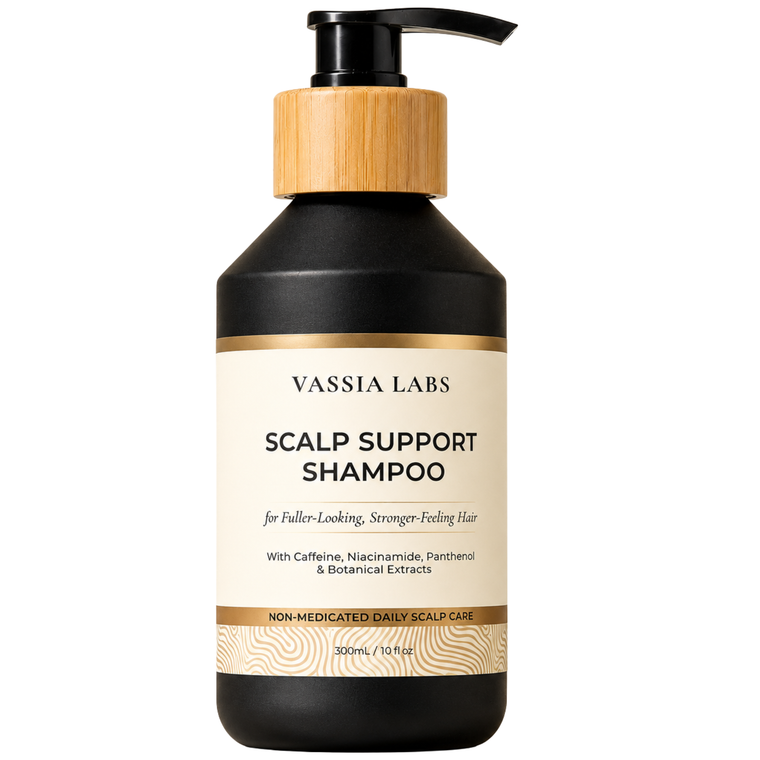
Vassia Labs Scalp Support Shampoo is a non-medicated, fragrance-free, sulfate-free and silicone-free cleanser for fine, flat and thinning-looking hair. Its role is lightweight cleansing and fuller-looking wash days, not treatment of a hormonal hair-loss condition.
When should you see a dermatologist?
Arrange professional assessment for a progressively widening part, a consistently smaller ponytail, smooth patches, persistent heavy shedding, recession, scalp pain or burning, sores, thick scale, scarring, eyebrow loss or another unexplained change in density. Earlier assessment is more useful than assuming every midlife change will resolve on its own.
Frequently asked questions
Is all hair thinning during perimenopause hormonal?
No. Hormonal transition may be part of the context, but female-pattern hair loss, temporary shedding, breakage, medications, illness, nutritional issues and scalp conditions can overlap.
Can oily or flat roots make hair look thinner?
Yes. Fine strands can clump together when coated with oil or product residue, exposing more scalp without necessarily changing follicle density.
Can shampoo reverse perimenopausal hair loss?
No cosmetic shampoo can reverse a medical hair-loss disorder. It can support cleansing, scalp comfort and the appearance of existing hair.