Fine hair after 40 does not need a shelf full of increasingly expensive products. It usually benefits from a simpler goal: keep the scalp clean, protect fragile lengths and avoid adding more weight than the strands can carry.
Hair can change through adulthood for many reasons, including hormones, genetics, coloring, heat styling, medications and ordinary aging. If density is clearly declining, cosmetic hair care can improve appearance and manageability but cannot diagnose the cause.
Step 1: Start with clean, lightweight roots
Fine hair loses visible volume quickly when oil and residue collect near the scalp. Wash often enough that the roots feel clean and comfortable rather than forcing long gaps between washes because a social-media routine told you to.
A lightweight shampoo should remove everyday buildup without leaving hair stiff or heavily coated.
Step 2: Condition the lengths, not the volume out of the roots
Conditioner becomes more important when hair is colored, dry or fragile, but placement matters. Apply richer products mainly to mid-lengths and ends. Fine roots rarely need the same amount of conditioning as older ends.
See Where Should You Apply Conditioner If Your Roots Go Flat?.
Step 3: Reduce mechanical damage
Fine strands can break more easily when handled roughly. Blot rather than rub wet hair, detangle gently and avoid forcing a brush through knots.
Heat is not forbidden, but repeated very high temperatures can increase damage. Use the lowest effective setting and keep the dryer moving.
Read How to Dry Fine Hair With Less Breakage.
Step 4: Create root lift with drying technique first
Before adding multiple styling products, try directing the roots away from the way they naturally lie. Dry the crown with lift, switch the part temporarily while drying, or use a round brush only where you need volume.
This creates shape without automatically adding another layer of residue.
Step 5: Use styling products selectively
Mousse can add body, root-lift spray targets the crown, and texture spray adds grip. Fine hair rarely needs all three at full strength.
Choose the product that solves your main styling problem and use the smallest amount that works. See Volumizing Mousse vs Root-Lift Spray vs Texture Spray.
Step 6: Do not let “thinning” marketing replace evaluation
If your part is progressively widening, your hairline changes or shedding increases for months, consider discussing it with a qualified healthcare professional. Shampoo can make existing hair look fuller, but it cannot diagnose or treat every cause of hair loss.
For the terminology, read Hair Density vs Thickness vs Volume.
A simple weekly routine
- Wash days: cleanse the scalp thoroughly; condition mainly from mid-lengths down.
- After washing: blot gently, detangle carefully and dry the roots for lift.
- Between washes: use dry shampoo only where needed rather than coating the entire scalp.
- When buildup appears: use a more thorough cleanse instead of stacking additional styling products.
- Every few weeks: reassess whether your products are helping or simply accumulating.
Where Vassia Labs fits
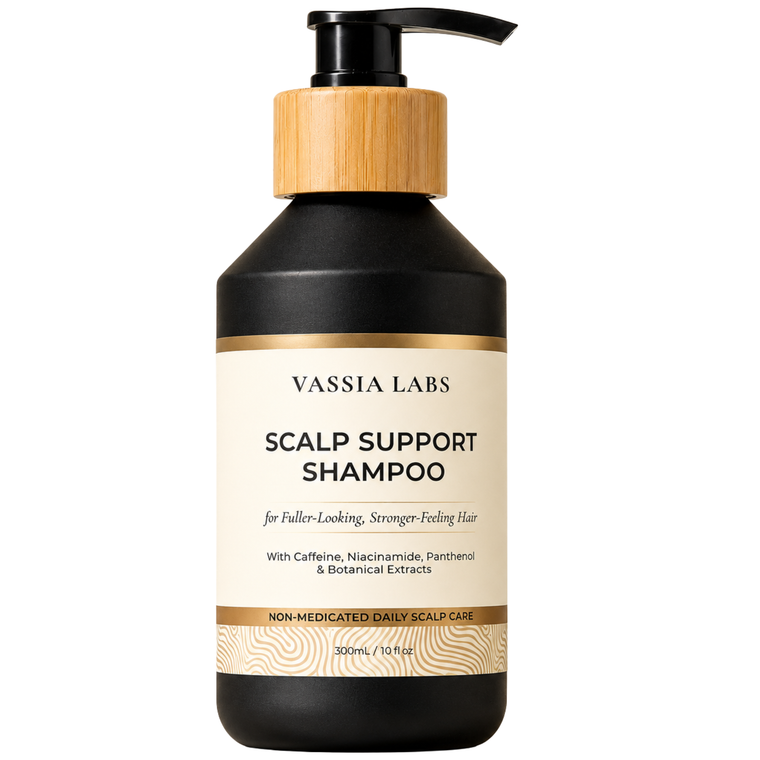
Vassia Labs Volumizing Shampoo for Fine, Flat & Thinning Hair is designed for fine hair that needs root cleansing and volume without a heavy finish.
The fragrance-free, sulfate-free and silicone-free formula includes caffeine, rosemary, niacinamide, panthenol, ginseng, aloe, centella, hyaluronic acid, zinc PCA and hydrolyzed wheat protein. It is designed to support cleaner roots, softer strands and fuller-looking volume.
It remains a non-medicated cosmetic shampoo.
Frequently asked questions
Why does fine hair look flatter with age?
Changes in density, strand characteristics, oil production, damage history and styling can all affect visible volume. There is no single explanation for everyone.
Should women over 40 wash fine hair less often?
Not automatically. Wash according to your scalp's oil, comfort and product use. Fine hair may look better with regular cleansing because oil reduces root lift quickly.
What is the easiest way to add volume without buildup?
Start with clean roots and drying technique. Add one lightweight styling product only if needed.
Bottom line
A useful fine-hair routine after 40 is not complicated. Clean the scalp, protect the lengths, minimize unnecessary coating and make styling products earn their place.