Hair milk can work well for fine hair when it adds slip and softness without leaving a heavy coating. The label “milk” is not a standardized formula category, however, so some products are genuinely light while others behave more like rich leave-in conditioners.
Hair milk vs leave-in conditioner vs oil
| Product type | Typical role | Fine-hair watch-out |
|---|---|---|
| Hair milk | Light conditioning, slip and softness | Formula can still be rich despite the lightweight name |
| Leave-in conditioner | Detangling, softness and moisture support | Too much near the roots can reduce volume |
| Hair oil | Lubrication, shine and sealing the surface | Small amounts can visibly weigh down fine strands |
When hair milk is most useful
- Fine lengths tangle easily after washing.
- Ends feel dry but the scalp becomes oily quickly.
- You want some slip before detangling without using a heavy mask.
- Hair needs a small amount of softness before heat styling.
How to use hair milk without flattening fine hair
- Start on the mid-lengths and ends rather than automatically applying it to the scalp.
- Use the smallest amount that gives useful slip, then add more only if needed.
- Apply on damp or dry hair according to the product label.
- Judge the result after the hair is fully dry. Soft and mobile is useful; stringy, greasy or collapsed means the product or amount is too heavy.
Signs you may have too much leave-in product
Fine hair can show overload quickly. Roots or lengths may look stringy, feel waxy, lose movement or become flat soon after washing. If that happens, simplify the styling layers and reassess rather than adding more product to “fix” the heaviness.
Commercial bridge: keep hydration away from the root-lift problem
For a full routine around lightweight conditioning, use the Complete Guide to Fine Hair and Why Does Conditioner Make Fine Hair Stringy or Flat?.
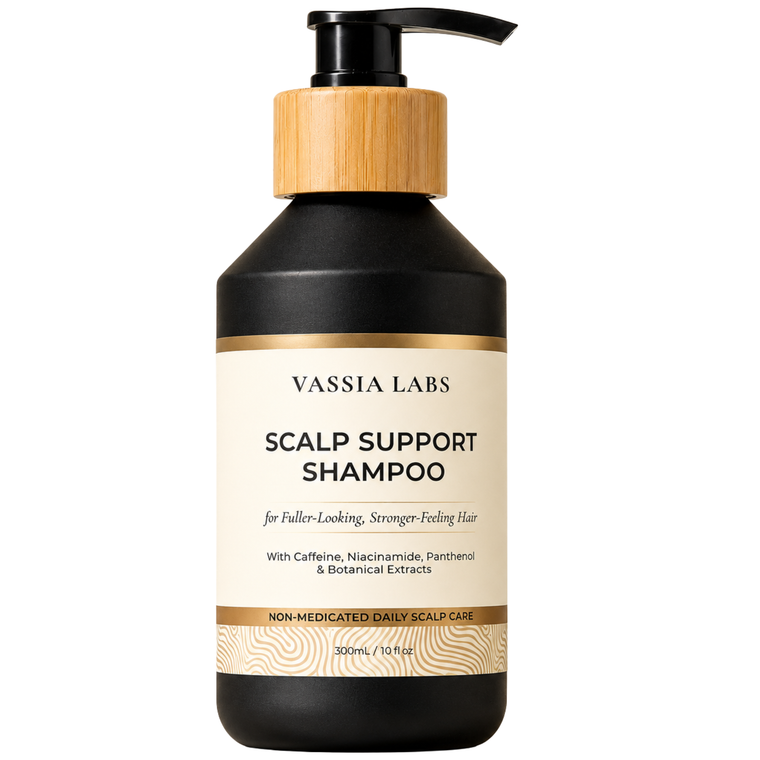
Vassia Labs Scalp Support Shampoo is designed to handle the cleansing side of that routine. It is fragrance-free, sulfate-free and silicone-free and is formulated for fine, flat and thinning-looking hair. A hair milk, if you use one, belongs mainly in the conditioning/styling part of the routine rather than replacing shampoo.
Frequently asked questions
Is hair milk good for fine hair?
It can be, especially when the formula is light and used mainly where the lengths need slip. The name “hair milk” does not guarantee a lightweight result.
Should hair milk go on the roots?
Usually not when root volume is the goal, unless the product is specifically designed and labeled for scalp or root use.
Can hair milk cause buildup?
Any leave-in product can contribute to residue if the formula is rich, the dose is high or multiple products are layered repeatedly.