PDRN and polynucleotide hair research is emerging, but the human studies most often cited involve injections or procedures, not rinse-off shampoo. That distinction is the entire point. A scalp injection creates very different exposure from a cosmetic cleanser that is rinsed away after a short contact time.
What does the PDRN hair evidence actually study?
| Evidence | Delivery | What was measured | What it proves for shampoo |
|---|---|---|---|
| 2015 female-pattern hair-loss study | Repeated intra-perifollicular PDRN injections, with a PDRN-only group and a PDRN + PRP group | Hair counts and thickness over time | It does not establish efficacy for rinse-off shampoo |
| 2025 androgenetic-alopecia study | Four polynucleotide scalp-injection sessions | Hair density and diameter | It supports further procedure research, not a shampoo claim |
| Cosmeceutical/review literature | Broader PDRN/PN mechanisms and delivery systems | Biological rationale and formulation questions | Mechanistic plausibility is not finished-product proof |
See the 2015 PDRN injection study in female-pattern hair loss and the 2025 polynucleotide injection study in androgenetic alopecia. Both are relevant to the research landscape, but neither tested shampoo.
PDRN vs polynucleotides: do the names mean the same thing?
The terms are related but are not a license to treat every material, formulation and procedure as identical. Source material, purification, molecular characteristics, delivery route, dose and finished-product design matter. Marketing often collapses these differences because the shorter explanation fits better on a bottle. Biology remains less cooperative.
What can a PDRN shampoo reasonably claim?
Without appropriate finished-product evidence, a cosmetic rinse-off shampoo should be judged on ordinary cosmetic outcomes such as cleansing, residue, scalp comfort, manageability and the visible body of existing hair. It should not borrow results from injected PDRN or polynucleotide procedures and present them as shampoo results.
Evidence hierarchy for a trendy shampoo ingredient
- Finished-product human study in the same format: strongest evidence for the exact product claim.
- Human study using a different delivery route: useful context, but not interchangeable with shampoo.
- Laboratory or mechanistic evidence: explains why research may be worth doing, not whether a consumer shampoo works clinically.
- Ingredient presence on a label: tells you the ingredient is there, not the outcome it produces.
Commercial bridge: compare PDRN without the hype
Use the Shampoo Ingredient Encyclopedia for Fine Hair to compare PDRN with caffeine, rosemary, niacinamide, panthenol and other ingredients using the same evidence standard. Then read Best Volumizing Shampoo for Fine Hair: What to Look For before judging a finished formula.
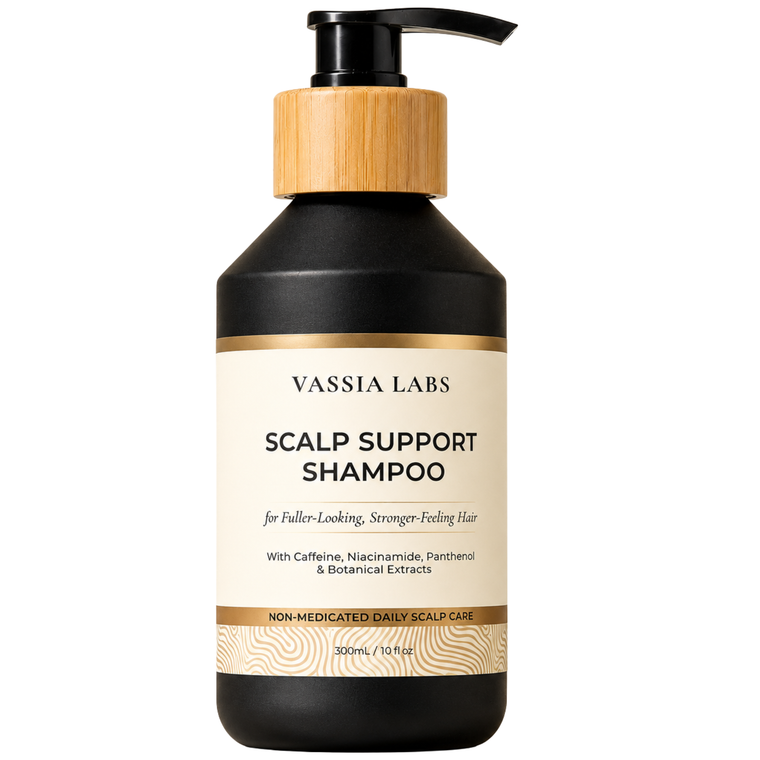
Vassia Labs Scalp Support Shampoo is a fragrance-free, sulfate-free and silicone-free cosmetic shampoo for fine, flat and thinning-looking hair. It is not presented as a PDRN procedure or medical hair-loss treatment.
Frequently asked questions
Does PDRN shampoo regrow hair?
Current human evidence does not establish that a typical rinse-off PDRN shampoo regrows hair. The better-known hair studies use injection-based delivery.
Are PDRN injections proof that PDRN shampoo works?
No. Delivery route, dose, exposure and formulation are fundamentally different.
Should I avoid PDRN shampoo?
Not necessarily. The point is to judge it as a cosmetic formula and not pay a premium solely because procedure-level research has been repackaged as a shampoo promise.