In 2026, the most interesting hair-care trend is not another styling technique. It is the idea that the scalp should be treated more like skin.
The beauty industry has given this shift a predictably marketable name: scalp skinification.
Behind the label is a reasonable idea. The scalp is skin. It has a barrier, oil glands, a microbiome and its own tolerance for cleansing, friction and active ingredients.
The mistake is assuming that because a twelve-step facial routine exists, your scalp is now morally obligated to have one too.
What is scalp skinification?
Scalp skinification is the use of skin-care principles and ingredients in hair and scalp products.
That includes:
- gentler cleansing
- barrier-support ingredients
- humectants such as hyaluronic acid
- niacinamide
- antioxidants
- chemical exfoliants
- microbiome-focused formulas
- targeted leave-on scalp serums
The trend is especially visible in Korean and Japanese hair care, where scalp analysis and multi-step scalp treatments have become a larger part of mainstream beauty culture.
Why the trend makes sense
For decades, shampoo marketing focused heavily on the hair fiber: shine, smoothness, repair, color protection and styling.
The scalp often appeared only when dandruff was involved.
That is changing. Consumers are increasingly thinking about oil balance, buildup, scalp comfort, barrier function and how the condition of the scalp relates to the way hair looks and feels.
Recent 2026 beauty coverage from Vogue and Marie Claire has highlighted scalp care, ingredient-led formulas and Korean scalp-spa practices as major parts of the current hair-care conversation.
The useful lesson: cleanse the scalp, condition the hair
One of the simplest skinification principles is also one of the most useful.
Shampoo is primarily a scalp-cleansing product. Conditioner is primarily a hair-fiber product.
For fine hair, this separation is especially helpful. It allows you to clean the roots properly while keeping richer conditioning mainly where it is needed: the lengths and ends.
If your scalp becomes oily quickly, extending wash day indefinitely is not automatically a sign of better scalp health. A comfortable scalp and clean roots are more useful goals than winning an imaginary contest for the longest time between shampoos.
Niacinamide: familiar from skin care, increasingly common in hair care
Niacinamide is a form of vitamin B3 used widely in facial skin care because of its relationship with barrier function and skin conditioning.
It now appears frequently in scalp formulas.
That does not mean a niacinamide shampoo should be marketed as a medical hair-growth treatment. Its more defensible role is as part of a scalp-care formula designed around comfort and conditioning.
Read Niacinamide for the Scalp: Why It Appears in Hair Care for a deeper look.
Hyaluronic acid and humectants
Hyaluronic acid is another ingredient that moved from facial care into scalp care.
It is a humectant, meaning it binds water. In a hair-care formula, the useful question is not whether hyaluronic acid is fashionable. It is whether the overall product leaves the scalp comfortable and the hair appropriately conditioned.
Fine hair needs hydration without excessive coating. This is why lightweight humectants can make more sense than adding increasingly heavy oils to every step of the routine.
See Hyaluronic Acid for the Scalp: Hydration Without the Hype.
The scalp microbiome: interesting, but not a magic phrase
The scalp hosts communities of microorganisms just like other areas of skin. Research into the scalp microbiome is growing, particularly around dandruff and scalp conditions.
For everyday cosmetic care, the takeaway should remain modest: avoid unnecessary irritation and use cleansing that suits your scalp.
A product saying “microbiome-friendly” does not automatically prove it improves hair density, growth or shedding.
Our guide Scalp Microbiome Care: What It Means for Shampoo and Scalp Health separates the useful science from the packaging vocabulary.
Where skinification goes wrong
The face and scalp are both skin, but they are not identical environments.
The scalp is densely covered with hair follicles and sebaceous glands. Hair itself also complicates product application and rinsing.
That means copying a facial routine directly onto the scalp can create problems.
Common mistakes include:
- stacking several exfoliating acids
- using physical scrubs too aggressively
- layering heavy leave-on products that flatten fine roots
- treating every tingle as evidence that a product is “working”
- adding so many steps that buildup becomes the new problem
A better scalp-skinification routine for fine hair
Fine hair usually benefits from restraint.
- Cleanse consistently. Use a shampoo that removes oil and residue without leaving the scalp persistently tight.
- Condition strategically. Keep heavier conditioning products through the lengths rather than automatically applying them at the root.
- Add one targeted step only when there is a reason. For example, occasional clarifying if you use heavy styling products.
- Protect the exposed scalp. A visible part line can receive significant sun exposure, so hats or suitable scalp sun protection can be useful outdoors.
- Escalate persistent symptoms to a professional. Chronic itching, redness, scale, pain or hair loss deserves assessment rather than an expanding shelf of cosmetics.
Where Vassia Labs fits
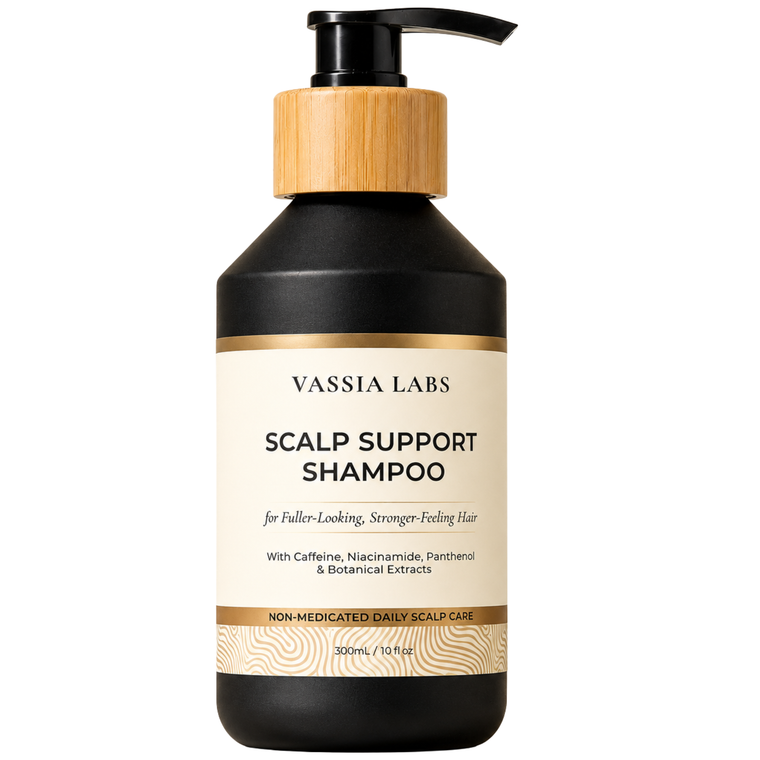
Vassia Labs Scalp Support Shampoo takes the scalp-skinification idea and removes the ten unnecessary steps.
The fragrance-free, sulfate-free and silicone-free formula combines gentle cleansing with niacinamide, hyaluronic acid, aloe, centella, zinc PCA and betaine, alongside caffeine, rosemary, ginseng, panthenol and hydrolyzed wheat protein.
The formula is designed for people who want scalp-focused care without sacrificing the immediate cosmetic goal that matters for fine hair: clean, soft, lifted roots that do not feel coated.
For the Korean influence behind the wider trend, read K-Beauty Scalp Care for Fine Hair: 7 Lessons Worth Borrowing in 2026.
Frequently asked questions
Is scalp skinification just marketing?
The term is marketing language, but the underlying principle is sensible: the scalp is skin and can benefit from appropriate cleansing, barrier-conscious care and well-chosen ingredients.
Do I need a scalp serum?
Not necessarily. A serum can be useful when it targets a specific need, but a complicated routine is not automatically a better one. Compare formats in Scalp Serum vs Shampoo.
Can skin-care ingredients regrow hair?
Do not assume so. An ingredient can support scalp condition without being a proven treatment for a hair-loss disorder.