If you see much more hair in the shower after going several days without washing, the larger amount does not automatically mean your hair suddenly started shedding faster. Loose strands can remain caught among the rest of your hair and become visible together when you finally shampoo, rinse and detangle. A longer gap between washes can therefore make one wash day look dramatic even when the underlying pattern has not changed.
The important question is not simply how much hair you see after one wash. It is whether your overall shedding pattern, hair density, part width or ponytail thickness is changing over time.
Why can more hair appear after several days without washing?
Hair that has already detached does not always fall immediately to the floor. It can stay caught between neighboring strands, especially in longer hair, textured hair, tied styles or hair that has not been brushed much between washes.
When you finally wash, several things happen at once: water separates strands, shampoo and rinsing move loose hairs, and detangling releases strands that had been trapped. The result can be a larger-looking collection in your hands, drain or brush.
The American Academy of Dermatology notes that people can notice increased hair in the brush or on the pillow during periods of excessive shedding, and that many different events and conditions can affect shedding. See the AAD overview of hair-loss causes.
Why the amount can look worse than it is
- Several days are being seen at once. Comparing a three-day wash gap with a daily wash is not an equal comparison.
- Long strands look like a lot of hair. A small number of long hairs can occupy a surprisingly large area in the shower or brush.
- Loose strands can stay trapped. Styles, texture and neighboring hairs can hold already-released strands until washing or detangling frees them.
- Breakage can be mixed in with shedding. Rough detangling can snap fragile hair, making the pile look larger even though not every strand came from the root.
Shedding and breakage are different
Shedding means an entire hair strand has released from the follicle as part of the hair cycle or because the cycle has been affected by another factor.
Breakage means the hair shaft snaps somewhere along its length. Broken hairs may be shorter than your full hair length and can contribute to thinner-looking ends or reduced visible fullness.
Hair is also more vulnerable to mechanical damage when handled roughly. The American Academy of Dermatology advises gentle hair-care practices and notes that wet hair can break more easily for many hair types. Read the AAD guidance on styling hair without damage.
If you are unsure which you are seeing, our guide to hair shedding vs. hair breakage explains the visual differences in more detail.
Does washing less reduce hair shedding?
Washing less can change when you see loose hairs, but it does not necessarily change the underlying reason those hairs were released. Delaying shampoo can simply allow more detached strands to accumulate before they become visible.
That is why judging your hair by one unusually large wash-day pile can be misleading. A better comparison is wash day against another wash day with a similar interval.
The AAD also cautions that hair loss has many possible causes and that changing hair-care habits alone does not address every cause. See the AAD's hair-loss management guidance.
How to assess what is actually happening
- Compare similar wash intervals. A daily wash and a wash after three or four days should not be expected to look identical.
- Look beyond the drain. Pay attention to whether your part is becoming wider, your ponytail feels persistently smaller or overall density appears to be declining.
- Detangle gently. Work through knots gradually instead of dragging a brush through them and adding avoidable breakage.
- Watch the pattern over time. One wash day is weak evidence. Persistent change over weeks or months is much more informative.
- Notice scalp symptoms. Pain, marked redness, inflammation, scaling or other persistent scalp changes deserve more attention than the number of hairs in one shower.
What not to do
- Do not avoid washing solely because seeing loose hair makes you anxious. That can simply postpone when already-loose strands become visible.
- Do not count every strand after every wash and assume normal day-to-day variation means something has suddenly changed.
- Do not detangle aggressively after a long wash gap. Extra friction can add breakage to the hairs that were already going to be released.
- Do not assume a cosmetic shampoo can diagnose or treat unexplained hair loss.
How often should you wash fine or thinning-looking hair?
There is no universal number of days that is right for every scalp. Wash frequency depends on oil production, sweat, styling-product use, hair texture, scalp comfort and personal preference.
If fine hair becomes oily and flat quickly, stretching wash days simply to meet an arbitrary schedule can make the roots feel heavier without solving shedding. Our detailed guide explains how often to wash fine or thinning-looking hair.
Where shampoo fits in
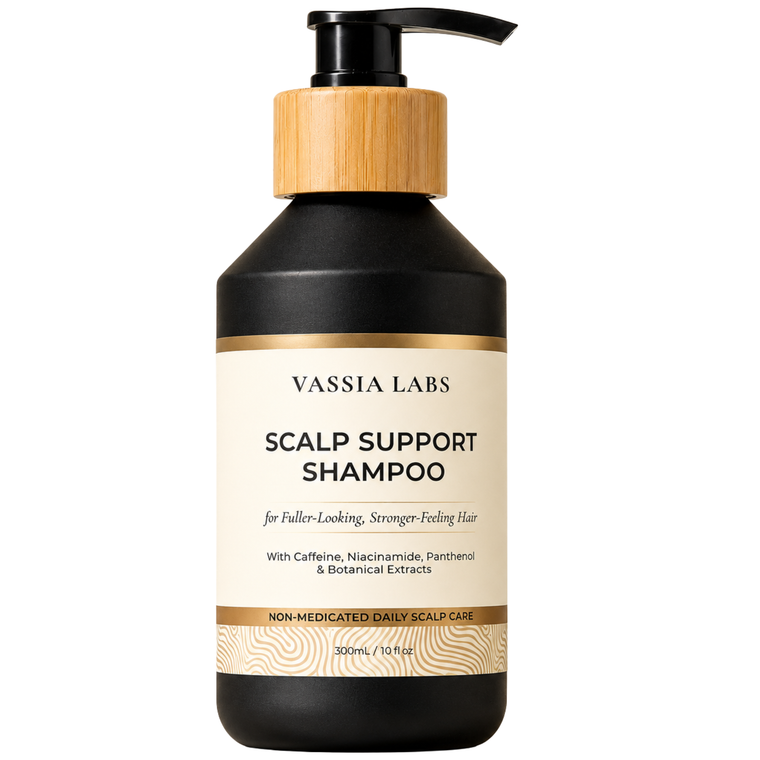
Shampoo's role is cleansing. It can remove scalp oil, sweat and product residue and make hair easier to manage, but a non-medicated cosmetic shampoo does not stop hairs that have already completed the process of being released.
For people whose main cosmetic concerns are fine strands, flat roots, buildup and thinning-looking hair, Vassia Labs Volumizing Shampoo for Fine, Flat & Thinning Hair is designed to cleanse with a lightweight, fragrance-free, sulfate-free and silicone-free formula. It is not a treatment for alopecia or another medical cause of hair loss.
When should increased shedding be checked by a dermatologist?
Consider professional evaluation when the change is sudden, persistent or accompanied by other meaningful signs rather than relying on wash-day counting alone.
Examples that deserve attention include:
- a progressively widening part or clearly decreasing density
- smooth bald patches
- persistent scalp pain, inflammation or significant irritation
- substantial shedding that continues rather than settling
- loss of eyebrows, eyelashes or other body hair
- a noticeable change following illness, childbirth, major stress, medication changes or another health event
The American Academy of Dermatology notes that a widening part can be an early sign of female-pattern hair loss and that different forms of hair loss require different approaches. Read the AAD overview of female-pattern hair loss.
For a more detailed decision guide, see When Hair Shedding Needs a Dermatologist.
Frequently asked questions
Why do I lose more hair when I finally wash it?
You may be seeing several days of already-released strands at the same time. Washing, rinsing and detangling make trapped loose hairs visible together.
Does not washing your hair make more hair fall out?
A longer wash interval can make the amount seen on wash day look larger. That alone does not prove the underlying shedding rate increased. Persistent density changes are more meaningful than one wash-day pile.
Can brushing after several days cause extra hair loss?
Rough brushing can increase hair-shaft breakage. Gentle detangling reduces avoidable mechanical damage, but it cannot prevent a strand that has already been released from becoming visible.
Should I wash my hair more often if I am shedding?
Wash frequency should primarily suit your scalp, oil level, styling routine and comfort. Washing more or less often does not substitute for evaluating persistent or unexplained shedding.
When is wash-day shedding concerning?
Seek appropriate professional advice when shedding is sudden or persistent, when density appears to be decreasing, or when you develop bald patches, scalp inflammation or other significant symptoms.